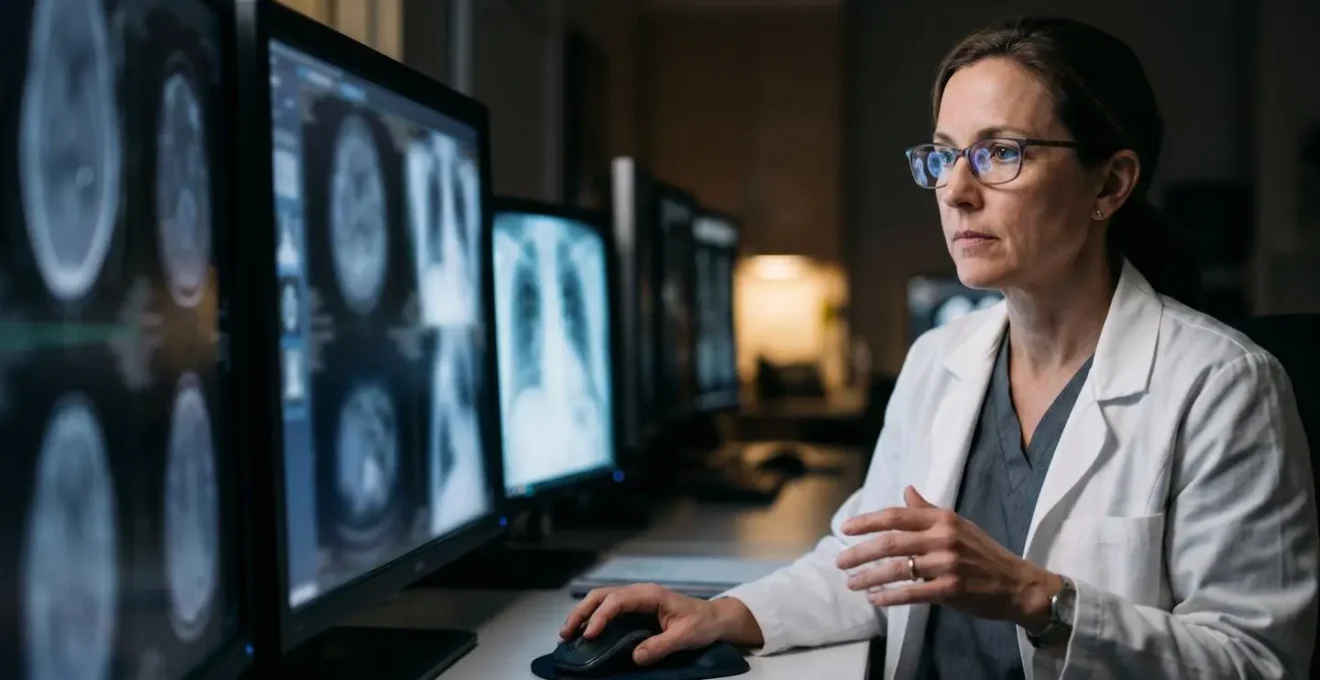
A radiologist’s job isn’t just to spot abnormalities; it’s to provide the definitive ‘diagnostic roadmap’ that guides every subsequent medical decision.
- They are trained to differentiate critical “signals” from benign “noise” like incidentalomas.
- They determine the right imaging tool (CT vs. MRI) for a specific diagnostic question.
- Their expertise provides a crucial safeguard that AI cannot yet replicate for complex and rare cases.
Recommendation: Actively engage with your imaging report and understand the immense value of a second read to ensure absolute diagnostic certainty.
The hum of the machine, the disembodied voice from the speaker, the clinical chill of the room—for most patients, a medical scan is an impersonal and often intimidating experience. You are told to hold your breath, stay perfectly still, and then you wait. Days later, a report appears in your patient portal, or your primary doctor relays the findings. The person who interpreted those complex, monochrome images remains a shadowy figure, a name at the bottom of a report. It is easy to think of them as a technician, someone who simply “takes the picture.”
But what if this invisible physician is the most critical member of your care team, especially when facing ambiguous symptoms? The reality is that the radiologist is a “diagnostic detective.” Their role is not passive observation but an active, intellectual process of data synthesis. They integrate the thousands of images from your scan with your clinical history, lab results, and previous studies to construct a comprehensive diagnostic roadmap. This roadmap doesn’t just identify a problem; it defines its precise location, character, and relationship to other structures, providing the crucial guidance that surgeons, oncologists, and other specialists need to plan your treatment effectively.
This article will pull back the curtain on this vital medical specialty. We will explore the tangible ways a radiologist’s expertise directly impacts your diagnosis and outcome, from managing the risks of contrast dye to deciding when a high-resolution scan is truly necessary. You will gain a new appreciation for the doctor you may never meet, but whose judgment is paramount to your care.
Summary: Unveiling the Critical Role of the Diagnostic Radiologist
- Why AI Cannot Yet Replace A Human Radiologist For Rare Pathologies?
- How To Flush Contrast Dye From Your System Post-Scan?
- CT Scan or MRI: Which Is Safer For Soft Tissue Injuries?
- The “Incidentaloma” Trap That Leads To Unnecessary Biopsies
- When To Demand A Second Read Of Your Mammogram?
- Why Are High-Res Scanners Louder Than Jet Engines?
- Why The Written Report Is Not Enough For A Complex Surgical Referral?
- 3T vs 1.5T MRI: When Is High-Resolution Scanning Strictly Necessary?
Why AI Cannot Yet Replace A Human Radiologist For Rare Pathologies?
The promise of Artificial Intelligence in medicine is immense, yet the narrative that AI will soon replace radiologists overlooks a fundamental aspect of diagnosis: context. AI algorithms are powerful when trained on vast datasets of common conditions. However, their performance falters when confronted with rare pathologies or atypical presentations, precisely where expert human judgment is most critical. A human radiologist performs a complex act of synthesis that goes far beyond pattern recognition.
Radiologists may consider the patient’s history, symptoms, laboratory results, and prior imaging studies when interpreting an image, which are essential for distinguishing pathologies such as osteomyelitis from mimics like fractures.
– ScienceDirect Research Team, AI in radiology: From promise to practice − A guide to effective integration
This ability to integrate disparate pieces of information—the story behind the images—is the core of the diagnostic detective work. An AI might flag an anomaly, but it cannot, for instance, weigh the significance of that anomaly in a patient with a specific genetic predisposition or an unusual travel history. The radiologist’s expertise lies in this nuanced interpretation, protecting patients from misdiagnosis when the case deviates from the textbook examples that AI models are trained on. It is the difference between recognizing a shape and understanding a situation, a gap that for the foreseeable future, only human expertise can bridge.
How To Flush Contrast Dye From Your System Post-Scan?
Contrast dye, or media, is a substance that enhances the visibility of internal structures during certain CT or MRI scans, allowing the radiologist to see details that would otherwise be invisible. While essential for diagnosis, patients are often concerned about how this substance is cleared from the body. The primary mechanism for elimination is through the kidneys and urinary system. For patients with normal kidney function, most iodinated or gadolinium-based contrast agents are significantly cleared from the bloodstream within a day or two.
The most crucial factor in supporting this natural process is adequate hydration. Drinking plenty of water both before and after your scan helps your kidneys function efficiently, filtering the contrast medium out of your blood and expelling it through urine. While severe reactions are rare, supporting your body’s natural clearance mechanism is a simple and effective measure. Your healthcare team may also provide specific instructions, especially if you have pre-existing kidney conditions or are taking certain medications like metformin.

To ensure a smooth process, patients can take several proactive steps to support their system post-scan. The fundamental principle is to facilitate the kidneys’ job of filtration.
- Drink plenty of water before the imaging test, unless your healthcare professional has specifically instructed fluid restriction.
- Continue drinking adequate water after the procedure to support kidney function. For patients with normal kidney function, contrast dye is typically cleared within 24-48 hours.
- Your healthcare professional may provide IV fluids before and/or after your test to ensure proper hydration.
- Monitor for any unusual symptoms and contact your doctor if you experience signs of slow clearance.
- Follow all medication instructions given by your doctor, especially regarding any temporary discontinuation of certain drugs.
CT Scan or MRI: Which Is Safer For Soft Tissue Injuries?
When a patient presents with an injury to muscles, ligaments, tendons, or cartilage, a common question arises: which imaging modality is better, a CT scan or an MRI? While both are powerful diagnostic tools, they operate on different principles and excel in different areas. The choice is not about which one is universally “safer,” but which one provides the necessary diagnostic information with the appropriate risk-benefit profile for the specific clinical question. A CT (Computed Tomography) scan uses X-rays to create cross-sectional images and is exceptionally fast and excellent for visualizing bone, calcifications, and acute bleeding. An MRI (Magnetic Resonance Imaging), on the other hand, uses powerful magnets and radio waves, involving no ionizing radiation.
For soft tissue injuries, MRI is unequivocally the superior modality for detailed evaluation. It offers unparalleled contrast resolution between different types of soft tissues, allowing radiologists to precisely identify subtle ligament tears, tendon inflammation, or muscle damage that would be indistinct or completely invisible on a CT scan. As a comprehensive comparison of imaging modalities shows, the decision involves a trade-off between speed, radiation exposure, and diagnostic detail.
| Criteria | CT Scan | MRI |
|---|---|---|
| Radiation Exposure | Uses ionizing radiation (X-rays) | No ionizing radiation (uses magnetic fields) |
| Speed of Scan | Very fast (about 1 minute) | Slower (10+ minutes) |
| Soft Tissue Detail | Good, but less detailed than MRI | Excellent contrast resolution for soft tissues |
| Best Use Cases | Emergency trauma, ruling out fractures, internal bleeding | Ligament tears, tendon injuries, muscle damage, nerve visualization |
| Contraindications | Pregnancy (use with caution) | Metal implants, pacemakers, severe claustrophobia |
| Contrast Agent Risks | Iodinated contrast (kidney concerns) | Gadolinium contrast (kidney function concerns in severe CKD) |
Therefore, while a CT might be used in an emergency setting to quickly rule out a fracture accompanying a soft tissue injury, an MRI is the definitive tool for characterizing the extent of the soft tissue damage itself. The radiologist’s role is to recommend the most appropriate test to answer the clinical question, ensuring the highest diagnostic yield while minimizing unnecessary radiation exposure.
The “Incidentaloma” Trap That Leads To Unnecessary Biopsies
One of the great paradoxes of modern high-resolution imaging is the “incidentaloma”—an unexpected finding discovered on a scan performed for an entirely different reason. As scanners become more powerful, their ability to detect tiny, clinically insignificant abnormalities increases. Studies show that incidental findings occur in approximately 20-40% of CT and MRI scans. These might be benign cysts, small nodules, or other variations of normal anatomy. The challenge for the radiologist, and the potential trap for the patient, is distinguishing this benign “noise” from a medically significant “signal.”
Case Study: The Imbalance of Incidental Findings
A study of CT pulmonary angiograms performed in an emergency department for suspected pulmonary thromboembolism (blood clot in the lung) revealed a striking disparity. The condition being investigated, pulmonary thromboembolism, was detected in only one in ten patients. However, one in four scans revealed an incidental finding, such as a pulmonary nodule or enlarged lymph gland. This demonstrates how imaging can inadvertently screen non-target organs, creating a “diagnostic cascade” of anxiety and further invasive testing, even when the original suspected condition is absent.
An inexperienced or overly cautious approach can lead to a cascade of further tests, follow-up scans, and even unnecessary biopsies, causing significant patient anxiety and healthcare costs. The expert radiologist acts as a crucial filter. Using established guidelines and a deep understanding of pathology, they can confidently classify most incidentalomas as “leave-alone” lesions, sparing the patient from the physical and psychological burden of over-investigation. This judgment call is one of the most important, yet least visible, services a radiologist provides.
Your Action Plan: Intelligent Questions to Ask About Incidental Findings
- What are the specific radiological features (e.g., size, shape, borders) that make this finding low-risk or high-risk?
- Is the follow-up recommendation based on a standardized scoring system like BI-RADS or Lung-RADS?
- What is the actual statistical likelihood of malignancy for this type of incidental finding in my age group and clinical context?
- What are the potential harms and benefits of pursuing further investigation (like a biopsy) versus a strategy of watchful waiting with follow-up imaging?
- Does this finding require action now, or can it be monitored safely over time?
When To Demand A Second Read Of Your Mammogram?
Mammography is a cornerstone of breast cancer screening, but its interpretation is a complex perceptual task where human factors play a significant role. A second opinion, or “second read,” is a process where a second, independent radiologist reviews the original imaging study. This is not a sign of a lack of confidence in the initial report, but rather a robust quality assurance measure. It is particularly critical in breast imaging, because among all types of incidental findings across different organs, breast incidentalomas showed the highest malignancy prevalence at 42% in one study, highlighting the high stakes.
Several situations should prompt a patient or their physician to consider a second read. These include having extremely dense breast tissue, which can obscure small cancers on a standard mammogram; a personal or strong family history of breast cancer; or receiving a report that feels ambiguous or doesn’t align with physical symptoms. A second read can provide crucial reassurance in the case of a negative finding or life-saving confirmation and clarification in the case of a suspicious one. It leverages the power of collaborative expertise to reduce the risk of a “perceptual miss”—where a subtle finding is overlooked by a single observer.

Ultimately, seeking a second opinion is a proactive step a patient can take to become an active participant in their own healthcare. It is an acknowledgment that diagnostic imaging is an interpretive science, and in cases of high complexity or high stakes, two expert sets of eyes are unequivocally better than one. This ensures that the diagnostic certainty is as high as possible before any treatment decisions are made.
Why Are High-Res Scanners Louder Than Jet Engines?
Anyone who has undergone an MRI scan can attest to the deafening cacophony of knocks, bangs, and clanks. This intense noise is not a sign of malfunction; on the contrary, it is the sound of the scanner performing its complex work. The primary source of the noise is the rapid switching of electrical currents within the gradient coils, which are large, powerful electromagnets that create slight, temporary alterations in the main magnetic field. These alterations are essential for spatially encoding the signal that generates the detailed images. The more powerful the scanner and the faster the imaging sequence, the more intense these vibrations become.
The loud knocking is caused by vibrating gradient coils, and the faster and stronger they vibrate, the higher the resolution and the faster the scan. The noise is literally the sound of creating a clearer picture for the radiologist.
– Medical Imaging Technical Specialists, Understanding MRI Technology and Patient Experience
This noise is a significant factor in the patient experience, contributing to anxiety and claustrophobia. In fact, claustrophobia severe enough to terminate the MRI exam is reported in up to 5% of patients. Radiologists and technologists are acutely aware of this and employ strategies like providing earplugs or headphones with music to mitigate the discomfort. Understanding the source of the noise—that it is a byproduct of generating the high-quality images needed for an accurate diagnosis—can help demystify the experience and reframe the sound not as a threat, but as a necessary component of a powerful diagnostic process.
Key Takeaways
- A radiologist is a ‘diagnostic detective’, not a passive observer, synthesizing data to create a treatment roadmap.
- Understanding the difference between imaging types (CT/MRI, 1.5T/3T) and risks (incidentalomas) empowers you as a patient.
- Human expertise remains irreplaceable for rare conditions and complex cases, where clinical context is paramount.
Why The Written Report Is Not Enough For A Complex Surgical Referral?
The written radiology report is a masterwork of precision and brevity, a formal document that conveys findings to the referring physician. However, in cases of complex surgical planning—such as for a brain tumor or a complex cancer resection—the report is merely the starting point of a critical conversation. The static, two-dimensional nature of a written report cannot fully capture the dynamic, three-dimensional reality of the patient’s anatomy. A surgeon needs to understand not just that a tumor exists, but its exact relationship to critical blood vessels, nerves, and surrounding tissues.
This is where the radiologist’s role transcends that of a reporter and becomes that of a collaborative consultant. As noted by experts, they are in many ways the “doctor’s doctor.”
Radiologists are the doctor’s doctor. We usually interface with other physicians, but patients are also welcome to talk to a radiologist directly if they have questions about an exam.
– Dr. Fayad, Johns Hopkins Medicine, CT Scan Versus MRI Versus X-Ray: What Type of Imaging Do I Need?
Direct communication between the radiologist and the surgeon is often essential. The radiologist can use advanced 3D visualization software to virtually “walk” the surgeon through the patient’s anatomy, pointing out potential pitfalls and safe corridors for the surgical approach. This direct dialogue allows for a level of nuance and interactive problem-solving that a written report can never achieve. It is this collaborative interpretation that transforms a set of images into an actionable surgical plan, directly impacting the safety and success of the operation.
3T vs 1.5T MRI: When Is High-Resolution Scanning Strictly Necessary?
In the world of MRI, the numbers “1.5T” and “3T” refer to the strength of the main magnetic field, measured in units of Tesla. A 3T scanner has a magnetic field twice as strong as a 1.5T machine, which is often perceived by patients as being universally “better.” While it is true that recent improvements in magnet design including stronger magnetic fields up to 3 teslas have advanced imaging, the choice is far more nuanced. “More” is not always “better,” and the optimal scanner depends entirely on the clinical question being asked.
A 3T scanner offers a higher signal-to-noise ratio (SNR), which can be leveraged to produce images with finer detail or to acquire images more quickly. This is strictly necessary for specific applications like detailed brain imaging for multiple sclerosis plaques, subtle cartilage tears in a joint, or small-lesion detection in prostate imaging. However, this increased magnetic strength also comes with trade-offs. It can create more artifacts (image distortions), especially around metal implants, and can sometimes be more sensitive to patient motion. For many routine examinations, such as general abdominal scans, a modern 1.5T scanner provides excellent diagnostic quality with potentially faster scan times and fewer artifacts.
| Factor | 1.5T MRI | 3T MRI |
|---|---|---|
| Signal-to-Noise Ratio | Good quality – like well-lit photograph | Superior – like professional flash eliminating grain |
| Image Resolution | Standard diagnostic quality | Enhanced detail for subtle pathologies |
| Scan Time | Often faster | May be longer for equivalent sequences |
| Best Applications | General liver/abdominal scans, patients with metal implants | Tiny cartilage tears, subtle MS plaques, detailed brain imaging |
| Metal Artifact Behavior | Less image distortion near implants | More artifacts near certain metal implants |
| Availability | Widely available | More common at specialized centers |
| Claustrophobia Factors | Wider bore options available | Improving with newer designs |
The radiologist’s expertise is crucial in determining when the added power of a 3T scan is diagnostically essential versus when a 1.5T scan is not only sufficient but potentially preferable. It is their job to select the right tool for the job, ensuring that the most precise diagnostic answer is obtained in the most efficient and appropriate manner for each individual patient.
Understanding the layers of expertise, technology, and judgment involved in radiology transforms the perception of this field from a technical service to a cornerstone of modern medicine. By being an informed patient, you can better appreciate the critical thinking that underpins your diagnosis and partner more effectively with your entire care team. The next step is to use this knowledge to engage confidently in conversations about your own diagnostic journey.