
Fighting your natural biological rhythm—your chronotype—creates a state of internal chaos that sabotages both your energy and long-term health.
- Your body isn’t run by one clock, but an orchestra of them; when the brain’s clock is out of sync with your liver’s or muscles’, metabolic health suffers.
- External cues like light and food timing are powerful tools that can either disrupt or reset this internal orchestra, impacting hormones like cortisol and melatonin.
Recommendation: Instead of forcing a schedule that conflicts with your biology, focus on strategically managing your light exposure and meal times to send consistent, synchronizing signals to your body.
For many, the daily grind feels like a battle against an invisible force. You wake up groggy, push through an afternoon slump with caffeine, and find yourself staring at the ceiling at 3 AM, “tired but wired.” This frustrating cycle is especially familiar to night owls forced into a 9-to-5 world or shift workers whose schedules are in direct opposition to the sun. The common advice is to discover your “chronotype”—whether you’re a Wolf, a Bear, or a Lion—and follow a prescribed routine. But this advice often fails because it oversimplifies a profoundly complex biological reality.
The real issue isn’t about conforming to a pop-science animal category. It’s about a deeper, more disruptive state known as circadian misalignment. Your body doesn’t have a single master clock; it has an entire orchestra of them. Your brain has a central pacemaker, but your liver, muscles, and even your gut have their own independent rhythms. When you force a lifestyle that clashes with your innate biology, you don’t just feel tired; you create a state of internal desynchrony where these clocks play out of tune. This dissonance is what truly ruins productivity and lays the groundwork for chronic health issues.
This article moves beyond generic tips. As a chronobiologist, I will dissect the science behind this internal conflict. We will explore the powerful environmental cues, or Zeitgebers, that conduct your internal orchestra—primarily light and food. You will learn not just what to do, but *why* you’re doing it, gaining the knowledge to stop fighting your body and start working with it. We will explore the precise mechanisms of how late-night screen time disrupts hormones, how shift workers can “hack” their light exposure, and why the timing of your meals is just as critical as what’s on your plate. This is your guide to achieving true synchronization for peak performance and lasting health.
Summary: The Science of Syncing Your Internal Clocks for Better Health
- Why Scrolling Your Phone At 11 PM Destroys Tomorrow’s Energy?
- How To Hack Your Light Exposure If You Work The Graveyard Shift?
- The “Time-Restricted Eating” Window That Matches Your Liver Clock
- Wolf, Bear, or Lion: Does The Animal Chronotype Test Actually Work?
- East vs West: How To Adjust Your Body Clock For Transatlantic Travel?
- The 3-2-1 Rule: When To Stop Eating, Drinking, And Working Before Bed?
- Why You Wake Up Tired But Cannot Sleep At Night?
- Deep Sleep vs REM: Which Phase Is Critical For Physical Recovery?
Why Scrolling Your Phone At 11 PM Destroys Tomorrow’s Energy?
The seemingly harmless habit of scrolling through your phone before bed is one of the most potent ways to induce circadian misalignment. The problem lies in the intense, short-wavelength blue light emitted by screens, which your brain interprets as morning sun. This sends a powerful, yet incorrect, signal to your body’s master clock located in the suprachiasmatic nucleus (SCN) of the brain. The primary consequence is the sharp suppression of melatonin, the hormone that signals darkness and prepares your body for sleep. In fact, research shows that just a couple of hours of blue light exposure in the evening can cause a 55% decrease in melatonin, effectively pushing your biological night back by hours.
But melatonin suppression is only half of the story. This disruption creates a “hormonal see-saw” imbalance. As melatonin is suppressed, its opposing hormone, cortisol, can remain elevated. Cortisol is your primary stress and alertness hormone; its levels should naturally be at their lowest at night and peak in the morning to help you wake up. Evening blue light exposure can lead to an unnatural cortisol spike at night, creating the classic “tired but wired” state. You feel physically exhausted, yet your mind is racing and unable to shut down. This hormonal conflict not only delays sleep onset but also fragments sleep architecture, preventing you from reaching the deeper, more restorative stages of sleep. The result is not just a groggy morning, but a day spent with impaired cognitive function, poor mood regulation, and diminished energy reserves.
How To Hack Your Light Exposure If You Work The Graveyard Shift?
For shift workers, the advice to “avoid light at night” is not just impractical; it’s impossible. Your job requires you to be alert when your body is biologically programmed to sleep. In this scenario, you must strategically use light as a tool to create an artificial “day” and “night” that aligns with your work schedule. Light is the most powerful Zeitgeber (time-giver) for the human circadian system, capable of dramatically shifting your internal clock. Indeed, laboratory studies demonstrate that strategically timed bright light can induce phase delays of 7 to 9 hours in both central and peripheral circadian markers.
Hacking your light exposure isn’t about simply turning on a lamp; it requires a precise, multi-stage protocol. The goal is to maximize alertness during your “day” (your night shift) and promote sleep during your “night” (your daytime sleep period). This involves using high-intensity, blue-enriched light at the start of and during your shift to suppress melatonin and promote wakefulness. Conversely, it is just as critical to meticulously block light on your commute home and in your sleep environment to allow melatonin to rise and initiate sleep. This means creating a cave-like darkness in your bedroom, even when the sun is high in the sky.
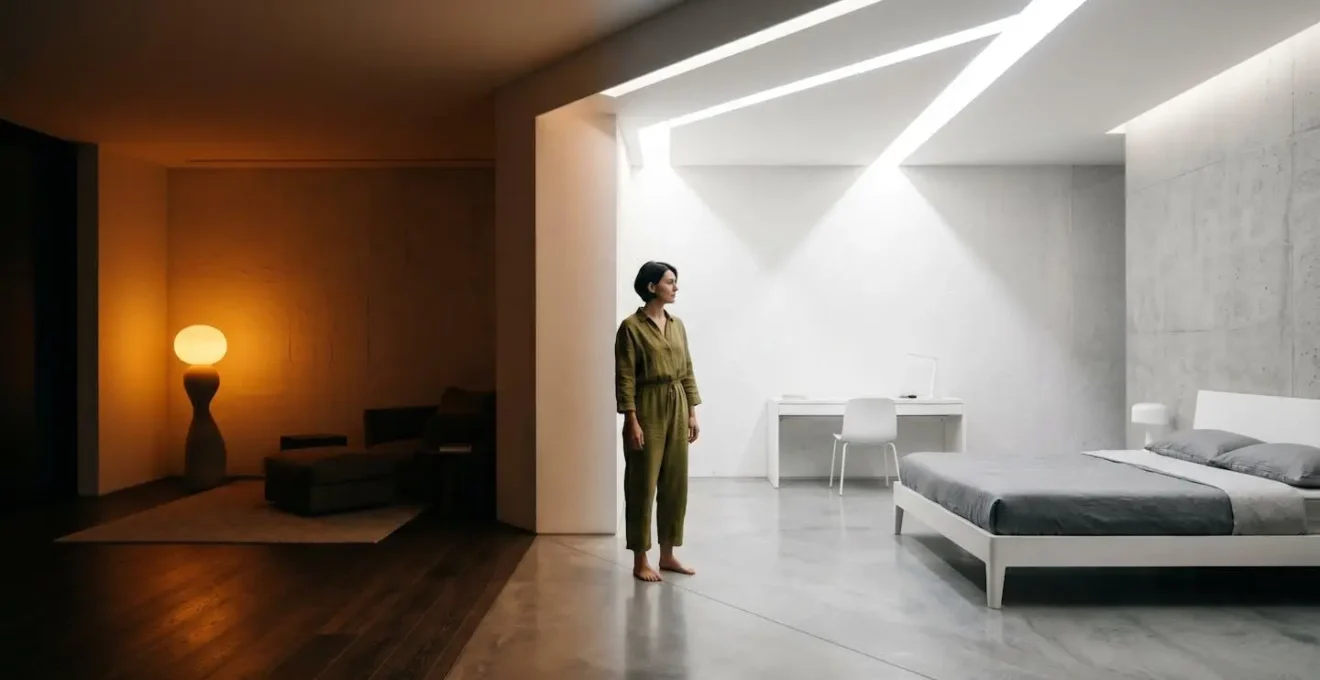
This deliberate manipulation of light and dark signals helps mitigate the health risks associated with chronic circadian misalignment, such as metabolic disorders and cardiovascular disease. By creating a consistent, albeit artificial, light-dark cycle, you provide your internal orchestra with the clear, rhythmic cues it needs to function, even when your schedule is inverted.
Action Plan: A Circadian-Informed Lighting Protocol for Night Shift Workers
- Upon waking for your night shift (e.g., 8 PM), use a 10,000 lux bright light therapy lamp for 20-30 minutes to suppress melatonin and signal the start of your “day.”
- During your shift, work under bright (over 300 lux), blue-enriched white lighting to maintain alertness and maximize the circadian delay signal.
- For your commute home in the morning, wear dark, wrap-around blue-blocking glasses (amber or red lenses) to prevent sunlight from prematurely resetting your clock.
- In your bedroom, use blackout curtains to create total darkness and switch to dim, red-light bulbs for any pre-sleep activities to preserve melatonin production.
The “Time-Restricted Eating” Window That Matches Your Liver Clock
While light is the primary conductor of your brain’s master clock, food is the dominant time-giver for your peripheral clocks, especially the metabolic clock in your liver. This means *when* you eat can be as important for your health as *what* you eat. When you eat at all hours, you send conflicting signals to your body, forcing your liver to be in “food processing” mode when it should be in “repair and detoxification” mode. This is a classic example of internal desynchrony, where your brain’s clock says it’s night, but your liver’s clock thinks it’s lunchtime.
Time-Restricted Eating (TRE), also known as a form of intermittent fasting, is a powerful strategy to resynchronize these clocks. By confining your food intake to a consistent window of 8-10 hours each day, you create a predictable daily fasting period. This allows the liver to cleanly switch from its daytime job of metabolizing nutrients to its nighttime job of cellular cleanup, a process called autophagy. During autophagy, the liver breaks down and recycles damaged cellular components, a critical process for preventing disease and promoting longevity. When you eat late at night, you interrupt this vital housekeeping. The benefits of aligning food intake with circadian rhythms are profound; for instance, a landmark Nature study revealed that night-specific autophagy induction extended the lifespan of fruit flies significantly.
For optimal health, the ideal TRE window should be aligned with the daylight hours, ending several hours before your natural bedtime. An early TRE window (e.g., 8 AM to 4 PM) appears to be more effective than a later one (e.g., 12 PM to 8 PM) because it aligns better with your body’s natural metabolic rhythms, which are highest earlier in the day. By matching your eating schedule to your internal clocks, you enhance metabolic efficiency, improve insulin sensitivity, and support the body’s innate repair mechanisms.
Wolf, Bear, or Lion: Does The Animal Chronotype Test Actually Work?
The popularization of animal-based chronotypes—Wolves (night owls), Lions (early birds), Bears (in-between), and Dolphins (poor sleepers)—has been a double-edged sword. On one hand, it has raised awareness that people have different biological rhythms. On the other, it often reduces a complex biological spectrum into overly simplistic, rigid categories. These tests are typically marketing tools, not scientifically validated instruments. While they can provide a general sense of your tendencies, they fail to capture the nuance of human chronobiology.
In the scientific community, chronotype is understood as a continuous distribution, much like height or weight. It isn’t a fixed label but a point on a spectrum from extreme “lark” to extreme “owl.” The gold standard for assessing this is through validated questionnaires like the Munich ChronoType Questionnaire (MCTQ), developed by leading chronobiologists. This tool calculates your chronotype based on your actual sleep patterns on work-free days, correcting for the sleep debt accumulated during the work week.

As chronobiologist Till Roenneberg, a creator of the MCTQ, and his colleagues explain, this scientific approach provides a far more accurate measure of your internal clock’s timing:
The MCTQ estimates chronotype based on the midpoint between sleep onset and offset on work-free days (MSF), corrected for oversleep due to sleep debt accumulated over the workweek (MSFsc). This MCTQ-proxy for chronotype is based on the assumption that sleep timing on work-free days is highly influenced by the circadian clock.
– Till Roenneberg et al., Munich ChronoType Questionnaire documentation, The Worldwide Experimental Platform
The key takeaway is to see your chronotype not as a rigid box but as your biological baseline. It’s influenced by genetics and changes throughout your life, typically shifting later during adolescence and earlier in older age. Rather than identifying as a “Wolf,” it’s more productive to understand where you fall on the scientific spectrum and use that knowledge to make informed, flexible lifestyle adjustments, not to follow a rigid, one-size-fits-all schedule.
East vs West: How To Adjust Your Body Clock For Transatlantic Travel?
Jet lag is the most acute and universally understood form of circadian misalignment. When you cross multiple time zones, your internal clock remains synchronized to your home environment while you are suddenly expected to function in a new one. The result is a profound desynchrony that causes fatigue, indigestion, and cognitive fog. However, not all travel is created equal. The direction of your travel significantly impacts the severity and duration of jet lag.
Traveling westward is generally easier for the body to adapt to than traveling eastward. The reason lies in the natural pace of our internal clock. Most humans have an endogenous circadian period that is slightly longer than 24 hours. As chronobiology research confirms that the natural circadian period is slightly longer than 24 hours, our bodies have a natural tendency to drift later each day (a “phase delay”). Westward travel, which requires you to stay up later and wake up later, aligns with this natural tendency. Eastward travel, conversely, requires you to go to bed earlier and wake up earlier (a “phase advance”), which goes against your clock’s innate drift, making the adjustment more difficult.
You can mitigate jet lag by strategically using the two most powerful Zeitgebers: light and melatonin. The goal is to send strong, clear signals to your master clock to help it shift to the new time zone. This requires a direction-specific approach:
- For Eastbound Travel (Phase Advance): Upon arrival, expose yourself to bright morning light as early as possible. This is the strongest signal to advance your clock. Avoid bright light in the late afternoon and evening. A low dose of melatonin (0.5-3 mg) taken in the late afternoon at your destination can also help pull your clock forward.
- For Westbound Travel (Phase Delay): Upon arrival, avoid bright morning light by staying indoors or wearing sunglasses. Instead, seek out bright light in the late afternoon and evening to help push your clock later. Melatonin is generally less helpful for westward travel.
- Pre-Adaptation: For a smoother transition, you can begin shifting your sleep-wake schedule by one hour per day for a few days before your trip, in the direction of your destination’s time zone.
The 3-2-1 Rule: When To Stop Eating, Drinking, And Working Before Bed?
The “3-2-1 Rule” is a simple yet powerful heuristic for timing your evening activities to promote better sleep and circadian alignment. It provides a practical framework for winding down by setting clear boundaries for your body’s key inputs: food, fluids, and mental stimulation. Each part of the rule is grounded in a specific biological mechanism.
3 Hours Before Bed: Stop Eating. This is about respecting your metabolic clock. Your liver and digestive system are not designed for heavy lifting at night. Finishing your last meal at least three hours before sleep gives your body time to digest and transition from nutrient processing to its critical nighttime roles of repair and detoxification. As we’ve seen, this allows for processes like autophagy to occur uninterrupted. It prevents the metabolic confusion that can lead to indigestion, acid reflux, and poor sleep quality.
2 Hours Before Bed: Stop Drinking Large Amounts of Fluid. While staying hydrated is important, tapering your fluid intake helps prevent your sleep from being disrupted by bathroom trips. During sleep, your brain releases an antidiuretic hormone called vasopressin, which concentrates urine and reduces the need to urinate. Drinking large volumes of liquid close to bedtime can override this system. This is especially true for alcohol, which not only acts as a diuretic but also suppresses REM sleep later in the night.
1 Hour Before Bed: Stop Working and Turn Off Screens. This final hour is for your brain. As we’ve established, the blue light from screens suppresses melatonin. But it’s also about reducing mental stimulation. Work, stressful conversations, and engaging content keep your cortisol levels and sympathetic nervous system (“fight or flight”) activated. Dedicating the last hour to relaxing activities—like reading a physical book, gentle stretching, or listening to calm music—helps shift your nervous system into a parasympathetic (“rest and digest”) state, signaling to your brain that it is safe to power down. The entire sleep-wake cycle is governed by a hormonal cascade, and circadian rhythm studies show that melatonin levels peak 4-6 hours before the cortisol rhythm crests, a delicate balance easily thrown off by late-night stimulation.
Key takeaways
- Your body is governed by an “orchestra” of internal clocks, and health depends on their synchronization.
- Light and food timing are the most powerful external cues (Zeitgebers) for resetting these clocks.
- Circadian misalignment, not just lack of sleep, is the root cause of feeling “tired but wired” and leads to long-term health risks.
Why You Wake Up Tired But Cannot Sleep At Night?
The paradox of feeling exhausted all day yet being wide awake at night is the quintessential symptom of severe circadian misalignment. It’s a sign that your body’s fundamental hormonal rhythms are in disarray. The “hormonal see-saw” between cortisol (alertness) and melatonin (sleepiness) is broken. Instead of a smooth, predictable handover from one to the other, your hormones are clashing, leaving you in a state of perpetual jet lag without ever leaving home.
Here’s what is happening biologically. In a healthy rhythm, you experience a sharp spike in cortisol within 30-60 minutes of waking, known as the Cortisol Awakening Response (CAR). This acts like a biological cup of coffee, making you feel alert and ready for the day. When your rhythm is delayed or disrupted—often due to late nights, blue light exposure, and mis-timed meals—this morning cortisol response becomes blunted. You wake up feeling groggy and unrefreshed because the “on” switch was never fully flipped. To compensate, you may rely on caffeine, which provides a temporary boost but does nothing to fix the underlying hormonal problem.
Then, as evening approaches, the other side of the see-saw fails. The cortisol that was missing in the morning now shows up late, remaining elevated into the night when it should be at its lowest. This elevated evening cortisol actively blocks melatonin from doing its job, preventing you from feeling sleepy and initiating the wind-down process. This is why you can feel physically drained but mentally wired. Your body is tired, but your brain is still receiving the “it’s daytime, stay alert” signal. As the Sleep Foundation notes, while you can train your daily schedule, your underlying genetic predisposition remains a powerful force:
Chronotype does not influence total sleep time. However, while circadian rhythm can be trained by adhering to a strict schedule, the underlying chronotype exists on a more permanent basis.
– Sleep Foundation, Chronotypes: Definition, Types, & Effect on Sleep
This state of being tired but wired is not a personal failing; it is a physiological signal that your lifestyle is in direct conflict with your biology. The solution is not to “try harder” to sleep but to systematically re-introduce the consistent light, food, and activity cues that your body needs to reset its internal timing.
Deep Sleep vs REM: Which Phase Is Critical For Physical Recovery?
When circadian misalignment disrupts your sleep, it doesn’t just reduce the quantity of your rest; it degrades the quality by altering your sleep architecture—the cyclical pattern of different sleep stages. The two most critical stages are Deep Sleep (also known as slow-wave sleep or NREM Stage 3) and REM (Rapid Eye Movement) sleep, each with a distinct and vital role. Chronic misalignment often robs you of one or both, with specific consequences.
Deep Sleep is paramount for physical recovery. This is the stage where your body does most of its repair work. Your brain activity slows dramatically, your muscles relax, and your body releases a surge of Human Growth Hormone (HGH). This hormone facilitates tissue repair, muscle growth, and bone building. Deep sleep is also when your glymphatic system—the brain’s waste clearance system—is most active, flushing out metabolic byproducts like beta-amyloid, a protein linked to Alzheimer’s disease. You typically get most of your deep sleep in the first half of the night. Therefore, a delayed sleep onset can significantly cut into this crucial recovery phase.
REM Sleep is critical for cognitive and emotional recovery. This is the stage associated with vivid dreaming. During REM, your brain is highly active, almost as if you were awake. This is when it consolidates memories, transferring information from short-term to long-term storage. It’s also vital for emotional regulation, processing the experiences of the day and softening the emotional charge of difficult memories. You get progressively longer bouts of REM sleep in the second half of the night, closer to your natural wake-up time. This means that forcing yourself to wake up earlier than your chronotype allows—a common struggle for “Wolf” types—often means sacrificing a significant portion of your REM sleep. Indeed, population studies indicate that Wolves (15-20% of the population) show higher rates of depressive symptoms and anxiety when experiencing this type of chronotype misalignment, a finding potentially linked to chronic REM sleep deprivation.
Ultimately, both stages are essential. Deep sleep rebuilds your body, and REM sleep rebuilds your mind. Fighting your chronotype puts both at risk, creating a deficit that is not just about feeling tired, but about compromising your physical and mental resilience day after day.
The journey to better health and productivity begins not with a war against your body, but with a respectful partnership. By implementing these science-backed strategies for managing light, food, and your daily schedule, you can begin to gently guide your internal orchestra back into harmony. Start today by taking one small, consistent step toward synchronization.