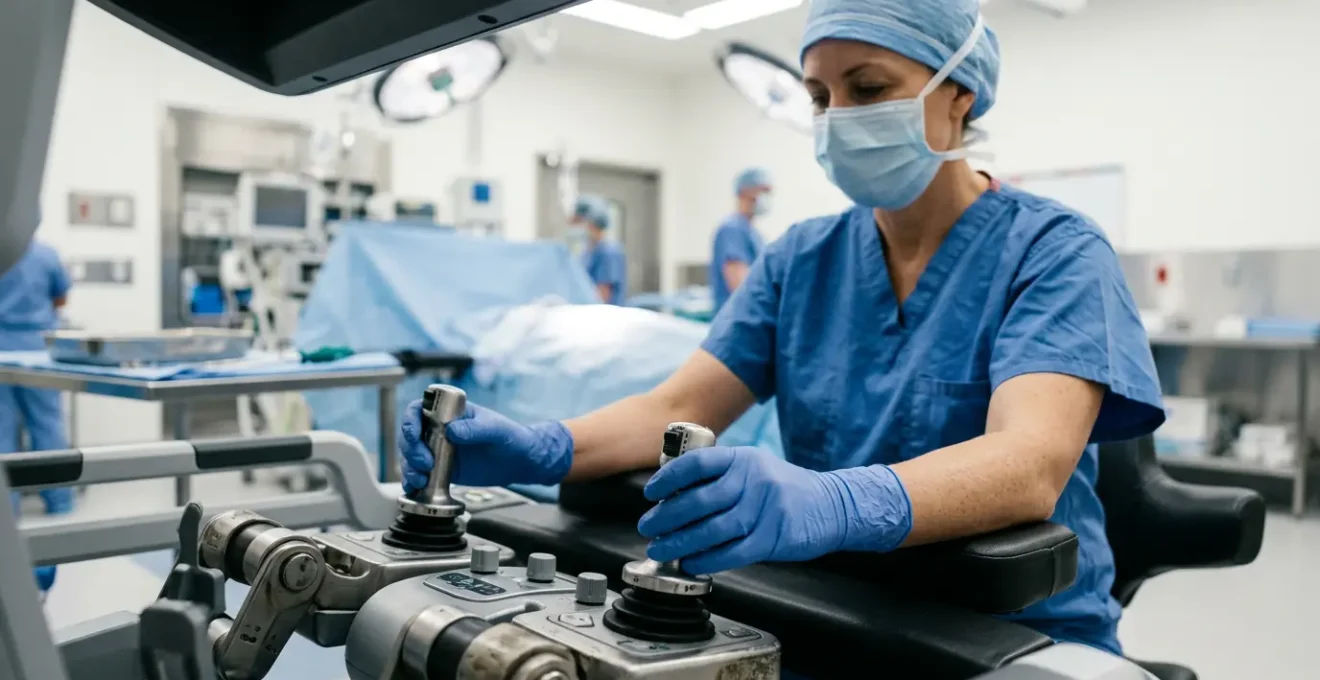
The real advantage of robotic surgery isn’t just speed; it’s a level of precision that fundamentally reduces surgical trauma at a microscopic level.
- Advanced robotics eliminate natural hand tremors and scale down a surgeon’s movements, allowing for superhuman steadiness in delicate procedures.
- However, this technological benefit is directly tied to the surgeon’s experience—the “learning curve” for a new robotic surgeon is a significant and measurable risk.
Recommendation: Focus your questions to the surgeon on their specific robotic case volume and the hospital’s credentialing protocols, not just on the technology itself.
When you’re facing surgery, the options can feel overwhelming. The choice between a traditional “open” procedure and a minimally invasive one often leads to a discussion about robotic surgery. You’ve likely heard the promises: smaller incisions, less pain, and a dramatically faster recovery. These are powerful motivators, and for many patients, they are the deciding factors. The conversation often revolves around getting back to your life sooner, a benefit that’s easy to understand and desire.
But this focus on speed, while valid, often obscures the more profound conversation. From my perspective as a surgical technologist—the person in the operating room who prepares and understands this technology intimately—the true story is more nuanced. The most significant benefits are not always the most visible ones. They are found in the microscopic details of the procedure itself, in the way the technology mitigates human limitations to reduce the underlying surgical trauma.
The real question isn’t just whether the higher cost is worth a faster recovery. The real question is: does the cumulative advantage of robotic precision offer a better surgical outcome for your specific situation? This guide moves beyond the hype. We will dissect the technology to show you how it works, confront the hidden risks tied to surgeon experience, clarify the confusing landscape of cost and insurance, and provide practical steps for planning both your physical and mental recovery. Our goal is to empower you to have a more informed, confident conversation with your healthcare team.
To help you navigate this complex decision, this article breaks down the key factors you need to consider. The following sections provide a detailed look at everything from the mechanics of surgical robots to the practicalities of recovery and cost.
Summary: Robotic Surgery vs Traditional: Is The Higher Cost Worth The Faster Recovery?
- Why Robotic Arms Eliminate Human Hand Tremors Completely?
- The Hidden Risk Of Being A Surgeon’s “First” Robotic Case
- Laparoscopy vs Robotics: Which Leaves The Smallest Scars?
- How To Plan Your Return To Work After Robotic Intervention?
- Is The $3,000 Extra For Robot-Assisted Surgery Covered By Insurance?
- Teaching Hospital or Private Clinic: Where Is Complex Surgery Safer?
- How To Plan For 6 Weeks Of Limited Mobility Without Depression?
- How Microsurgery Saves Severed Limbs When Standard Repair Fails?
Why robotic arms eliminate human hand tremors completely?
The defining feature of a robotic surgical system is its ability to grant a surgeon a level of steadiness that surpasses human capability. While it’s often said that robots “filter tremors,” the primary mechanism is actually far more sophisticated: motion scaling. This technology translates the surgeon’s larger hand movements at the control console into micro-movements of the instruments inside the patient’s body. A one-centimeter move of the surgeon’s hand might translate to a one-millimeter move of the instrument tip. This creates an environment of incredible stability, crucial for operating around delicate nerves and blood vessels.
This isn’t just a theoretical benefit. As a technologist, I see firsthand how this allows for dissections and sutures that are performed with unwavering precision. The system essentially creates a buffer against the natural, microscopic tremors present in every human hand, no matter how skilled the surgeon. According to a foundational study, this engineered stability is the key to superior accuracy. As the authors of a study in the Journal of Surgical Research note:
Motion scaling, rather than tremor filtration, plays the major role in the enhanced accuracy seen in robotic surgical systems.
– Study authors, Surgical robotics: Impact of motion scaling on task performance
The wristed instruments, which mimic and even exceed the dexterity of the human wrist, can articulate in seven degrees of freedom. This allows the surgeon to work in tight spaces from angles that would be impossible with traditional laparoscopic tools. This combination of scaled movement and enhanced dexterity is the foundation of robotic surgery’s clinical advantage, reducing unintended tissue damage and enabling more precise, nerve-sparing procedures.
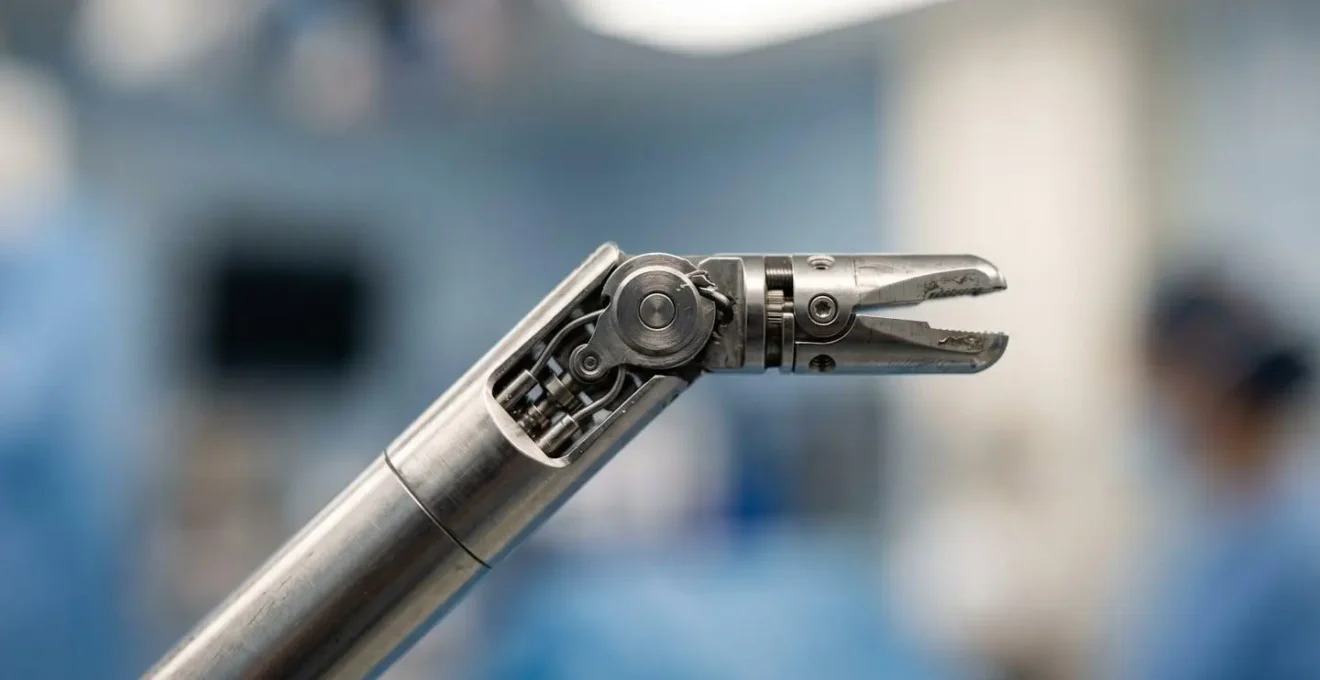
The image above illustrates the intricate engineering that makes this possible. Each joint is designed for flawless, repeatable motion. This mechanical perfection translates directly into a calmer, more controlled surgical field, which is the first step in reducing overall surgical trauma and paving the way for a smoother recovery.
The hidden risk of being a surgeon’s “first” robotic case
While the technology offers immense potential for precision, it is not autonomous. The robot is a tool, and its effectiveness is entirely dependent on the skill of the person at the controls. This introduces the most critical variable in robotic surgery: the surgeon’s experience. A steep learning curve is associated with mastering the robotic platform, and being one of a surgeon’s initial cases carries measurable risks. The hand-eye coordination is different from open or even laparoscopic surgery, requiring the surgeon to develop a new kind of muscle memory and spatial awareness based on a 3D-HD monitor.
The data on this is clear and sobering. Studies analyzing outcomes during a surgeon’s initial series of robotic procedures show a significantly higher rate of complications. For instance, a study on robotic colorectal surgery found that overall complications were 27% in the first 15 cases, which dropped dramatically to 6.3% after that initial period. This demonstrates a tangible risk associated with inexperience, including longer operation times, higher chances of converting to an open procedure, and increased post-operative issues.
This is why hospital credentialing and proctoring are so important. Reputable institutions have strict protocols, requiring surgeons to complete extensive simulation training and perform a number of cases under the supervision of an experienced proctor before they can operate independently. As a patient, it is not rude or inappropriate to inquire about this. It is your right to be an active participant in your care. An experienced, confident surgeon will have no issue discussing their case volume and the hospital’s safety protocols. This conversation is one of the most important you can have before consenting to surgery.
To facilitate this discussion, here are key questions you should ask:
- How many of this specific procedure have you performed robotically?
- What is the hospital’s credentialing process for new robotic surgeons?
- Do you work with a proctor for your initial robotic cases?
- What are the potential risks specific to robotic surgery in my case, including possible malfunction?
- What is the plan if a conversion to an open procedure becomes necessary during the operation?
Laparoscopy vs robotics: which leaves the smallest scars?
One of the most frequently cited benefits of any minimally invasive surgery, including both robotic and traditional laparoscopy, is the cosmetic outcome: smaller, less noticeable scars. Both techniques use small “keyhole” incisions to insert a camera and instruments. Intuitively, many patients assume that the more advanced robotic technology would naturally result in even better, smaller, or faster-healing scars. However, the reality is more complex and can be counter-intuitive.
While the incision *size* is generally comparable between the two methods, the nature of the robotic instruments can sometimes lead to different healing outcomes. Robotic trocars (the ports through which instruments are inserted) can be slightly larger and apply a different type of torque on the skin and underlying tissue compared to manual laparoscopic instruments. This can, in some instances, affect the final aesthetic appearance of the scar.
A surprising finding from a prospective study directly compared the two approaches. The study evaluating trocar site appearances one year after surgery found that wound appearance scores were significantly better in the laparoscopic group. Patients who underwent traditional laparoscopy had a higher proportion of “optimal” wound healing, with the difference being attributed to better scar color and overall healing quality rather than the size of the incision alone. This suggests that the gentle, direct manipulation by a surgeon in laparoscopy can sometimes be kinder to the tissue at the incision site.

This does not mean robotic surgery leaves large or unsightly scars; the cosmetic result is still vastly superior to traditional open surgery. However, it is a crucial piece of information that balances the narrative. If the absolute best cosmetic outcome is a primary concern, it’s a point worth discussing with your surgeon. The choice may depend on the specific procedure and your surgeon’s own technique and experience with minimizing tissue trauma at the port sites.
How to plan your return to work after robotic intervention?
A faster return to normal activities, including work, is a cornerstone of robotic surgery’s value proposition. Because the internal surgical trauma is minimized through precise movements and reduced tissue manipulation, the body’s inflammatory response is lessened. This translates into less pain, a shorter hospital stay, and a quicker recovery trajectory. For most patients, this is the most tangible benefit, directly impacting their quality of life and financial stability.
Generally, the timeline is significantly accelerated compared to open surgery. According to surgical outcome data, patients are often discharged from the hospital within just one to two days. The “full recovery” milestone, meaning a return to most daily activities without major restrictions, is typically reached around six weeks post-surgery, pending surgeon clearance. However, “return to work” is highly dependent on the nature of your job. An office worker may be able to return to part-time or full-time duties in as little as two to three weeks, while someone with a physically demanding job may need the full six weeks or more.
Planning is key to a smooth transition. Your recovery is not passive; it’s an active process. The first week is critical for setting the stage. While you need to rest, gentle mobility is essential to prevent blood clots and begin rebuilding strength. A gradual increase in activity is the goal. Below is a general milestone plan, which should always be adapted based on your surgeon’s specific instructions:
- Day 1: Focus on sitting up in a chair for at least an hour and practicing gentle breathing exercises to keep your lungs clear.
- Day 2-3: Begin short, slow walks, such as to the mailbox and back. Aim for several short walks rather than one long one.
- Day 4-5: Gradually increase walking duration to a full block, always monitoring your pain and fatigue levels.
- Day 6-7: Continue to extend walking distance as tolerated. Light stretching may be incorporated if your surgeon approves.
Before your surgery, have a frank conversation with your employer about potential timelines and the possibility of a phased return, perhaps starting with remote work or reduced hours. Preparing your workspace and delegating tasks ahead of time will reduce stress and allow you to focus entirely on healing.
Is the $3,000 extra for robot-assisted surgery covered by insurance?
The question of cost is often the biggest hurdle for patients considering robotic surgery. The technology is expensive to acquire and maintain, and those costs are passed on to the patient and their insurer. It’s true that, on average, robotic surgery costs around $3,000 to $7,000 more than an equivalent laparoscopic procedure. This significant difference naturally leads to the critical question: will my insurance cover it?
The short answer is generally yes, but the way it’s covered is what’s important to understand. Insurers do not typically pay a separate, additional fee just for using the robot. Instead, robotic surgery is categorized as a form of minimally invasive surgery. As the team at Far North Surgery explains, “any insurance covering minimally invasive surgery will also cover robotic surgery. This is true for popular insurance programs, such as Medicare.” The key is in the medical coding and the concept of reimbursement.
Your surgeon bills for the primary procedure (e.g., a prostatectomy), and the use of the robot is considered an integral part of how that procedure is performed. It is not an “add-on” from a billing perspective. This is a crucial distinction that can be seen in the specific policies of major insurers.
Case Study: UnitedHealthcare’s Reimbursement Policy
To understand how this works in practice, consider the official policy from a major insurer. The 2024 reimbursement policy from UnitedHealthcare explicitly addresses this. It states that the specific billing code for robotic assistance (S2900) is considered integral to the main surgical procedure and is not separately reimbursed. The payment for using the robot is bundled into the payment for the overall surgery. This means the insurer pays for the procedure, and the hospital/surgeon absorbs the cost of using the robot as part of their operational expenses. For the patient, this means your standard co-pays, deductibles, and co-insurance for a major surgery will apply, but you should not receive a separate bill labeled “robotic fee.”
Before your procedure, it is essential to get pre-authorization from your insurance company. Your surgeon’s administrative staff will handle this, but you should always confirm that it has been approved. Ask for a detailed estimate of your out-of-pocket costs, which will be determined by your specific plan’s deductible and co-insurance rates, not by the type of tool the surgeon uses.
Teaching hospital or private clinic: where is complex surgery safer?
When deciding on a location for a complex robotic surgery, patients often weigh the perceived personalized care of a private clinic against the vast resources of a large teaching hospital. While excellent surgeons practice in both settings, for high-stakes, technically demanding procedures, the data and underlying systems often favor major academic or high-volume centers. The key factors are not the size of the building, but case volume, multidisciplinary support, and a culture of standardized protocols.
High-volume hospitals, which are often teaching institutions, perform a greater number of specific robotic procedures. This constant practice hones the skills of not just the lead surgeon, but the entire surgical team—from the anesthesiologist to the circulating nurses and surgical technologists like myself. We develop a rhythm and an ability to anticipate and react that only comes with repetition. This team-based expertise is a critical component of safety and efficiency in the operating room. Such centers are also more likely to have dedicated robotic surgery programs with rigorous credentialing and ongoing quality review.
Furthermore, the data supports the correlation between volume and better outcomes. For example, a large-scale analysis of robotic prostatectomies found that in high-volume hospitals, overall complications were significantly less for robotic surgery (10.6%) compared to open surgery (15.8%). While this study compares robotic to open surgery, it underscores the safety profile achievable in centers that have deeply integrated the technology and refined their processes around it.
Finally, teaching hospitals are inherently equipped to handle the unexpected. They have specialists from every field on-site 24/7, advanced imaging capabilities, and intensive care units prepared for any contingency. While complications are less likely with a skilled team, having this safety net is invaluable. When choosing where to have your surgery, look beyond the surgeon to the institution. Ask about their robotic program’s case volume for your specific procedure and the support systems they have in place. Often, the safest place is the one most prepared for the worst-case scenario, even if it rarely happens.
How to plan for 6 weeks of limited mobility without depression?
The promise of a “faster” recovery with robotic surgery can create a mental trap. While you may be out of the hospital in a day or two, you will still face a multi-week period of significant physical limitations. Your mind might feel ready to return to normal life long before your body is. This disconnect can be a recipe for frustration, boredom, and even post-operative depression. Proactively planning for your mental well-being during this period is just as important as planning your physical recovery.
The key is to shift your mindset from “being stuck” to “having a project.” Your recovery is not a passive waiting game; it’s an active, structured time for healing. The primary benefit of robotic surgery is indeed a faster recovery that allows patients to return to daily activities sooner, but embracing this period requires preparation. This is where the concept of mental “pre-hab” comes in—setting up your environment and expectations to support your psychological health before you even go into surgery.
This involves creating a “recovery nest”—a comfortable space where everything you need is within arm’s reach: medications, water, healthy snacks, books, a laptop, and entertainment. It also means managing social expectations. Let friends and family know you’d love visitors, but perhaps schedule them in short, manageable bursts to avoid exhaustion. Having a specific, low-energy project can also provide a sense of purpose, whether it’s organizing digital photos, taking an online course, or finally tackling that stack of books on your nightstand.
Maintaining a sense of control and purpose is the best defense against the helplessness that can accompany limited mobility. The following checklist can help you structure your plan.
Your Mental Pre-hab Checklist for a Positive Recovery
- Delegate and Arrange: Clearly assign specific household tasks (e.g., grocery shopping, pet care) to family members or arrange for temporary help before your surgery date.
- Structure Social Contact: Plan a “post-op visitor” rotation with friends and family to ensure regular social connection without becoming overwhelmed.
- Build Your ‘Nest’: Set up a primary recovery area with all essentials within reach, minimizing the need to get up for non-essential items.
- Choose Your ‘Recovery Project’: Select a specific, achievable project to work on, such as completing an online course, organizing a photo album, or following a curated reading list.
- Plan Micro-Outings: Schedule small, low-energy “outings” for weeks 2-3, like sitting on the porch or taking a short car ride as a passenger, to combat feelings of being confined.
Key Takeaways
- Precision Over Speed: The primary advantage is motion scaling, which reduces microscopic surgical trauma, a benefit more profound than just a faster recovery.
- The Surgeon is Key: The technology is a tool. A surgeon’s experience and case volume are the most critical factors for a successful outcome. Don’t be afraid to ask about their learning curve.
- Cost is About Reimbursement: Insurance covers robotic surgery as part of the overall procedure. You won’t be billed separately for the “robot,” but your standard deductible and co-insurance apply.
How microsurgery saves severed limbs when standard repair fails?
While much of the discussion around robotic surgery focuses on abdominal and pelvic procedures, the ultimate expression of its precision is found in the emerging field of robot-assisted microsurgery (RAMS). Here, the principles of tremor elimination and motion scaling are applied to tasks at the very edge of human capability: reattaching blood vessels and nerves that are less than a millimeter in diameter. This technology is revolutionizing complex reconstructions, including saving severed limbs, that would be impossible with standard techniques.
In these delicate procedures, a natural hand tremor, invisible to the naked eye, becomes a significant obstacle. The robotic platform completely negates this, allowing surgeons to perform sutures on microscopic vessels with flawless consistency. The recent FDA approval and implementation of systems like the Symani Surgical System are proving this concept in clinical practice. A high-volume academic center recently reported on its first 100 consecutive cases, demonstrating how the technology enables surgeons to perform supermicrosurgery with enhanced precision and improved ergonomics, preventing the fatigue that can degrade performance during long, complex cases.
This application represents the full circle of the robotic surgery promise. The same core benefit—using technology to overcome human physical limitations—that provides a cumulative advantage in a prostatectomy becomes a procedure-enabling necessity in microsurgery. It shows that the value is not just in making common surgeries better, but in making previously impossible surgeries possible. For a patient facing a complex reconstruction, this technology can be the difference between a successful limb salvage and an amputation.
This look into the future of surgery reinforces the central theme: the true worth of this technology is rooted in its ability to deliver a level of precision that translates directly into better, safer, and sometimes, life-altering outcomes. It is a powerful testament to the ongoing innovation in the surgical field.
Ultimately, the decision to opt for robotic surgery is a personal one, weighing tangible costs against the cumulative benefits of enhanced precision. Armed with a deeper understanding of the technology, the risks, and the financial realities, you are now better equipped to partner with your surgeon and make the choice that is right for you. The next logical step is to schedule a consultation to discuss these points in the context of your specific health situation.