In summary:
- In a cardiac emergency, if someone is unconscious and not breathing, immediately call 911 and start Hands-Only CPR.
- Send someone to find an AED. Use it as soon as it arrives; the device will give you clear, calm instructions.
- The AED is designed for anyone to use. It analyzes the heart and will only advise a shock if it’s medically necessary.
- Your quick actions are the most critical part of the “Chain of Survival” and can dramatically increase the chance of saving a life.
Witnessing someone suddenly collapse is a terrifying experience, and the feeling of helplessness can be overwhelming. In those critical moments, your mind races with questions: Is it a heart attack? Should I do something? What if I make it worse? Many people freeze, not because they don’t care, but because they fear doing the wrong thing. The common advice is to “call 911 and wait,” but this overlooks the single most powerful tool a bystander has: immediate action.
The confusion between a heart attack and a sudden cardiac arrest is often the first hurdle, leading to fatal delays. While both are serious cardiac emergencies, they require fundamentally different responses. Understanding this difference is the first step toward building the confidence to act. This guide is built on a simple premise: you don’t need to be a medical professional to be a lifesaver. You just need to understand the ‘why’ behind the ‘what’.
This article will not just give you a list of commands. As your first aid trainer, I will walk you through the entire process, from recognizing the emergency to performing effective chest compressions and partnering with an Automated External Defibrillator (AED). We will demystify the machine, explain why it sometimes advises against a shock, and empower you with the knowledge that your intervention forms the most crucial link in the chain of survival. By the end, you won’t just know the steps; you’ll have the confidence to take them.
To help you navigate this critical information, we’ve broken down the process into clear, manageable sections. This structure will guide you from understanding the emergency to taking decisive, life-saving action.
Summary: How to Confidently Use an AED and Save a Life Before Help Arrives
- Why Confusing A Heart Attack With Cardiac Arrest Delays The Right Response?
- How To Perform Chest Compressions Without Mouth-To-Mouth?
- Public or Private: Where Are AEDs Usually Hidden In Office Buildings?
- The Silence Of Asystole: Why The AED Sometimes Says “No Shock Advised”
- How Every Minute Without Defibrillation Redues Survival By 10%?
- Chew or Swallow: What Is The Correct Aspirin Protocol For Chest Pain?
- Minimum Effective Dose: How Many Minutes Of Cardio To Lower Stroke Risk?
- How To Decide On Do-Not-Resuscitate Orders For Terminal Illness?
Why Confusing A Heart Attack With Cardiac Arrest Delays The Right Response?
The first critical step in any emergency is recognizing what you’re dealing with. A heart attack and a cardiac arrest both sound terrifying, but they are not the same. A heart attack is a “plumbing” problem: a blockage prevents blood from flowing to the heart muscle. The person is typically awake, conscious, and can complain of symptoms like chest pain. A cardiac arrest is an “electrical” problem: the heart’s electrical system malfunctions, causing it to stop beating effectively. The person will be unconscious and not breathing normally.
This distinction is vital because it dictates your role. If the person is conscious (heart attack), your job is to provide comfort and get professional help immediately. If they are unconscious (cardiac arrest), you are their only lifeline until the ambulance arrives. Any delay in starting chest compressions (CPR) and using an AED for a cardiac arrest victim is a delay they cannot afford. Starting CPR immediately is a foundational part of the Chain of Survival, and bystander intervention can be incredibly effective; immediate CPR can double or triple a person’s chances of survival after cardiac arrest.
Therefore, your first assessment is simple: are they conscious or unconscious? If they are awake and complaining of chest pain, call 911 and keep them calm. If they are unconscious and not breathing, shout for help, tell someone to call 911 and find an AED, and begin chest compressions without hesitation. You are no longer waiting for help; you are the help.
How To Perform Chest Compressions Without Mouth-To-Mouth?
Many bystanders hesitate to perform CPR because they are unwilling or untrained to give rescue breaths. The great news is that you don’t have to. For a teen or adult who has suddenly collapsed, Hands-Only CPR is the recommended approach for the general public. It’s simple, effective, and removes a major barrier to action. The ‘why’ is straightforward: when an adult suddenly collapses, their blood is still full of oxygen. The immediate priority is to manually pump that oxygenated blood to the brain and other vital organs, and chest compressions do exactly that.
This technique focuses on two critical actions: pushing hard and pushing fast in the center of the chest. The goal is a rate of 100 to 120 compressions per minute (to the beat of “Stayin’ Alive”) and a depth of at least 2 inches. This isn’t a gentle push; it requires you to use your body weight. Don’t worry about hurting the person—the alternative is far worse. Effective CPR is the bridge that keeps the brain alive until the AED can deliver its electrical therapy.
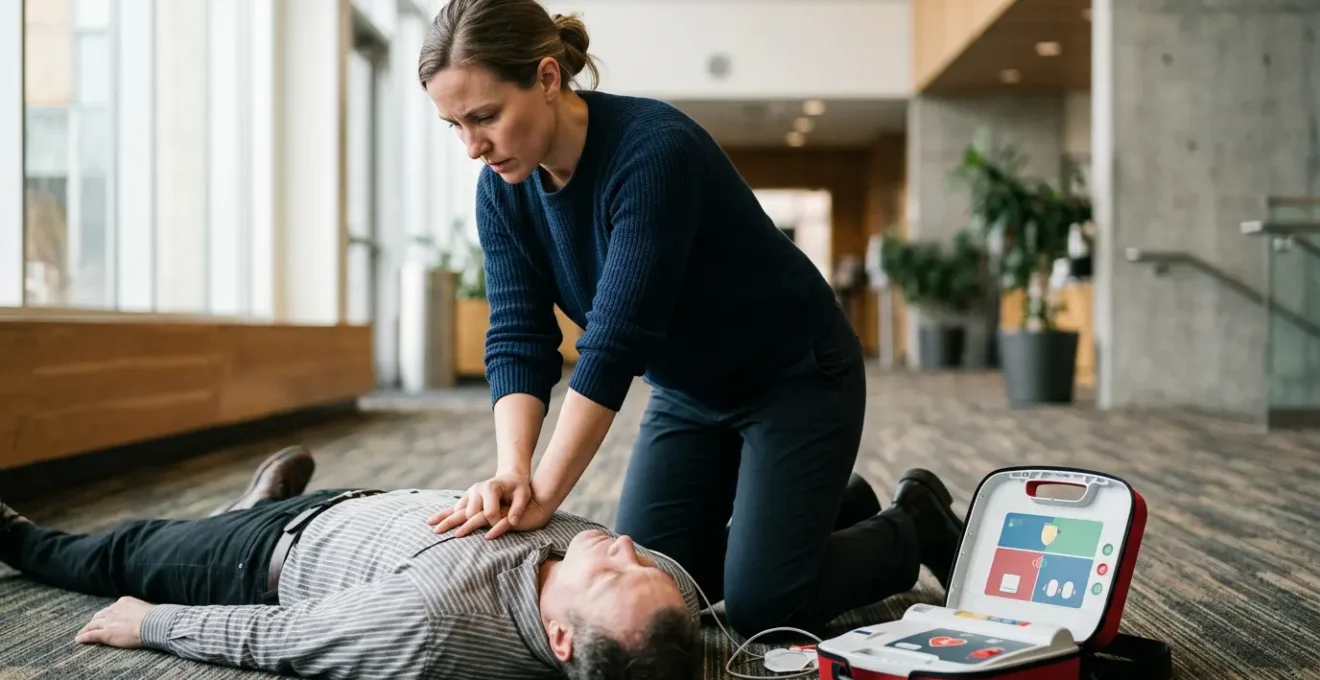
To perform Hands-Only CPR, kneel beside the person. Place the heel of one hand on the center of their chest (on the breastbone) and your other hand on top, interlacing your fingers. With your arms straight and your shoulders directly over your hands, push down hard and fast. Allow the chest to return to its normal position after each push. Continue without interruption until the AED arrives or emergency medical services take over. Research shows that in the first few minutes of a cardiac arrest, Hands-Only CPR is just as effective as conventional CPR with breaths.
As the image demonstrates, the key is the interlocking of the hands and the straight-arm posture, which allows you to use your body weight efficiently for deep, powerful compressions. This simple, single-focus action is easy to remember and perform, even under immense stress. Your two hands are all it takes to make a life-or-death difference.
Public or Private: Where Are AEDs Usually Hidden In Office Buildings?
While one person starts CPR, the next critical task is locating an AED. These devices are becoming more common in public spaces, but they can feel “hidden in plain sight.” A shocking statistic from the American Heart Association reveals that although 10,000 cardiac arrests occur in US workplaces annually, only 50% of people can locate an AED at work. This gap in awareness can be deadly. Knowing where to look before an emergency happens is a vital part of being prepared.
AEDs are strategically placed in areas of high traffic or high risk. Think about the busiest spots in your building. Your search should focus on these common locations:
- Central, high-traffic areas: Main lobbies near the reception desk, cafeterias, and primary hallways near elevator banks are top locations.
- High-risk zones: On-site gyms, large conference rooms, and auditoriums are prime spots due to the increased risk of cardiac events during exertion or large gatherings.
- With designated personnel: In many private buildings, the AED is kept with the security staff or a designated first aid officer (often in HR or Facilities), rather than being publicly mounted. Always ask them first.
- Follow the signs: Look for the standardized AED sign—a heart with a lightning bolt inside—which often includes directional arrows.
Proactive technology is also closing this awareness gap. Innovative tools are helping communities map out these life-saving devices, turning any smartphone into a potential lifesaver.
Case Study: PulsePoint AED Registry Success
The PulsePoint AED app has transformed how communities locate defibrillators by creating crowdsourced maps of AED locations. Anyone can report an AED’s location, which is then verified and made available to 911 dispatchers and nearby citizens during an emergency. The app integrates with dispatch systems, allowing operators to direct callers to the exact location of a nearby device while giving CPR instructions, significantly reducing the time to defibrillation and empowering bystanders to become active participants in the rescue.
The Silence Of Asystole: Why The AED Sometimes Says “No Shock Advised”
You’ve started CPR, someone has brought the AED, and you’ve attached the pads as shown on the device. The machine announces, “Analyzing heart rhythm, do not touch the patient.” You hold your breath, and then it says: “No shock advised. Continue CPR.” This can be a confusing and disheartening moment. Does it mean the person is okay? Does it mean the AED is broken? The answer is neither. This is the AED working perfectly as your diagnostic partner.
An AED is designed to treat only specific “shockable” heart rhythms. The most common one in sudden cardiac arrest is Ventricular Fibrillation (V-Fib), where the heart’s electrical activity is chaotic and quivering, preventing it from pumping blood. The AED’s electrical therapy is designed to stun the heart and reset this chaotic rhythm. However, not all cardiac arrests involve a shockable rhythm. Sometimes, the heart is in Asystole (a flatline), where there is no electrical activity at all. An electrical shock cannot restart a heart with no electrical activity; it would be like trying to reboot a computer that is already turned off and unplugged. Only CPR can help in this situation by manually circulating blood.
This is not a rare occurrence. In fact, a landmark study in the New England Journal of Medicine found that while about 61% of cardiac arrests present with a shockable rhythm like V-Fib, a significant portion present with non-shockable rhythms. When the AED says “No shock advised,” it has correctly identified a non-shockable rhythm. It is not a sign of failure; it is a critical piece of diagnostic information.
Your job in this moment is simple and crucial: trust the machine and immediately resume chest compressions. The AED will continue to monitor the heart and will re-analyze the rhythm every two minutes. By continuing high-quality CPR, you are giving the heart the best possible chance to potentially convert into a shockable rhythm that the AED can then treat. Your hands are the treatment until the machine says otherwise.
How Every Minute Without Defibrillation Reduces Survival By 10%?
In a sudden cardiac arrest, the clock is your greatest enemy. The heart has stopped pumping blood effectively, and the brain and other vital organs are being starved of oxygen. This is why every single second counts. The stark reality is that for every minute that passes without CPR and defibrillation, the chances of survival plummet. According to the American Red Cross, survival chances decrease by 10% for every minute that immediate intervention is delayed.
After just four to six minutes without blood flow, brain damage can begin. After ten minutes, the chances of survival are near zero. This isn’t a statistic meant to scare you; it’s meant to empower you by showing just how critical your immediate actions are. The ambulance may be ten minutes away, but the person’s chance of survival is disappearing right now. You are the bridge between the collapse and the arrival of professional help. Your hands performing CPR and the AED you retrieve are buying that person precious, life-saving time.
The good news is that this statistic works both ways. While delay is deadly, immediate action is incredibly effective. When the “Chain of Survival”—early recognition, early CPR, and early defibrillation—is put into motion quickly, the odds change dramatically in the victim’s favor. The purpose of public access defibrillation programs is to get that AED to the person’s side as fast as humanly possible. A long-term study highlighted the stunning impact of rapid response, showing that survival rates can exceed 50% when defibrillation occurs within the first few minutes. This is a monumental increase from the average survival rate of less than 10%.
Chew or Swallow: What Is The Correct Aspirin Protocol For Chest Pain?
Our focus has been on the unconscious victim of cardiac arrest, but what about the person who is conscious and complaining of chest pain—a potential heart attack? In this scenario, your role shifts from physical intervention to communication and support. After calling 911, the operator may ask if the person can take aspirin. This is because a heart attack is often caused by a blood clot, and aspirin is a potent anti-clotting agent. The landmark ISIS-2 trial found that aspirin use initiated within 4 hours of symptom onset reduced cardiovascular mortality by 25%.
However, giving medication is a serious step, and it should only be done with extreme caution and ideally under the guidance of a 911 operator. Before even considering it, you must run through a critical safety checklist to ensure you do no harm. Aspirin is not safe for everyone, and giving it to the wrong person can be dangerous. Never give anything by mouth to someone who is confused or losing consciousness.
If the 911 operator recommends it and the person is fully alert, the method of administration is crucial for speed. The instruction is to chew, not swallow. Chewing the aspirin allows it to be absorbed rapidly through the blood vessels in the mouth and under the tongue, getting it into the bloodstream much faster than if it had to go through the digestive system. When fighting a clot, every second counts.
Action Plan: The Layperson’s Aspirin Safety Checklist
- Call 911 First: Your absolute first step is to call for professional help. Never advise someone to take aspirin and “wait and see.” Follow the 911 operator’s instructions.
- Verify Consciousness: Only consider aspirin for a person who is fully conscious, alert, and able to swallow safely. Never give anything to an unconscious or confused individual.
- Ask Critical Safety Questions: Before proceeding, ask clearly: (1) Are you allergic to aspirin? (2) Do you have any bleeding disorders or active stomach ulcers? (3) Has a doctor ever told you to avoid aspirin? If the answer to any of these is yes, do not give aspirin.
- Use Correct Dosage and Method: If guided by 911 and safety is confirmed, the standard dose is one regular-strength (325mg) or two to four low-dose (81mg) aspirin tablets. Instruct the person to CHEW the tablet(s) thoroughly before swallowing.
- Understand the ‘Why’: Chewing allows for sublingual absorption, bypassing the stomach for a much faster anti-clotting effect. This rapid action is what can help limit heart muscle damage during a heart attack.
Minimum Effective Dose: How Many Minutes Of Cardio To Lower Stroke Risk?
While knowing how to respond to an emergency is vital, the ultimate goal is to prevent these events from happening in the first place. The “Chain of Survival” truly begins with a healthy lifestyle. Regular cardiovascular exercise is one of the most powerful tools we have to reduce the risk of both heart disease and stroke. But how much is enough? Many people are intimidated by intense workout regimens, but the “minimum effective dose” is more achievable than you might think.
The official guidance is clear and consistent. The American Heart Association recommends at least 150 minutes per week of moderate-intensity aerobic activity. “Moderate intensity” means you can still hold a conversation while doing it. This could be a brisk walk, cycling on level ground, or even vigorous gardening. That breaks down to just 30 minutes a day, five days a week. You don’t need to run a marathon; you just need to move consistently.
Even better, research has shown that you don’t even need to do it all at once. The concept of “exercise snacking” demonstrates that accumulating activity in short bursts throughout the day is just as beneficial for your heart health. This approach focuses on breaking up long periods of sitting with small, manageable bouts of movement.
Case Study: “Exercise Snacking” for Vascular Health
The ‘exercise snacking’ approach involves incorporating multiple 5-10 minute bursts of activity—like taking the stairs, doing a brisk walk around the block, or even active household chores—to collectively reach the weekly 150-minute goal. This method is highly effective for reducing stroke risk because it combats a sedentary lifestyle, which is a major risk factor. Studies show the biggest health gains come from moving from zero activity to some regular activity. For long-term vascular health, the consistency of daily movement matters more than the intensity of a single workout.
Key Takeaways
- Act Fast: If someone is unconscious and not breathing normally, call 911, start Hands-Only CPR, and use an AED as soon as possible.
- Trust the AED: The device is designed for untrained users. It provides clear voice prompts and will only shock if necessary. Your job is to listen and follow its instructions.
- CPR is Crucial: Continuous chest compressions are the bridge to survival, circulating oxygenated blood to the brain until the AED can work or help arrives.
How To Decide On Do-Not-Resuscitate Orders For Terminal Illness?
One of the deepest fears that can cause a bystander to hesitate is the thought, “What if this person didn’t want to be saved?” You might worry about Do-Not-Resuscitate (DNR) orders or see a tattoo that suggests the person has a terminal illness. This is a valid concern, but in a public emergency, the answer for a layperson is always the same: you must act. Your duty as a bystander is to presume the person wants to be saved.
Good Samaritan laws exist in most places to protect people who act in good faith to help in an emergency. You are not a medical professional and are not expected to interpret complex medical directives. Official DNR orders are legally binding documents, often in the form of specific bracelets, necklaces, or official state forms, which only trained EMS personnel can legally interpret and honor. A tattoo is generally not considered a legally binding medical directive. Your responsibility is to initiate the Chain of Survival without delay.
If you happen to find an official DNR document or medical alert jewelry while performing CPR, do not stop. Your job is to continue life-saving efforts and simply present that information to the paramedics or other professional responders when they arrive on the scene. They are the only ones who can make the official determination to cease resuscitation efforts. Your role is simple and clear: keep the person alive until the professionals take over. The decision to stop is theirs, not yours.
As the American Heart Association points out, this willingness to act is tragically uncommon. In their 2023 statistics, they noted:
Only about 40% of people who experience an out-of-hospital cardiac arrest get the immediate help that they need before professional help arrives.
– American Heart Association, 2023 Heart Disease and Stroke Statistics
Now that you understand the steps and have the confidence to act, the final piece is to make this knowledge a permanent part of your skillset. The next logical step is to find a certified hands-on first aid and CPR/AED course in your community. This practical training will solidify what you’ve learned and truly prepare you to be the help, not a bystander, when it matters most.
Frequently Asked Questions on How To Use An AED To Save A Life Before The Ambulance Arrives?
What is the correct compression rate for Hands-Only CPR?
Push hard and fast at a rate of 100 to 120 compressions per minute. The beat of songs like ‘Stayin’ Alive’ by the Bee Gees can help you maintain the correct pace.
How deep should chest compressions be for adults?
Compress the chest at least 2 inches (5 centimeters) deep for adults. You need to push hard enough to circulate blood to the brain and vital organs. Effective CPR requires significant force.
When should I use Hands-Only CPR versus conventional CPR with breaths?
Hands-Only CPR is recommended for untrained bystanders when they witness a teen or adult suddenly collapse. Conventional CPR with breaths is generally recommended for infants, children, drowning victims, or cases of drug overdose.
Should I stop compressions to check if the person is breathing?
No, do not stop chest compressions unless the person starts breathing normally on their own, an AED is analyzing the heart rhythm, or professional emergency responders arrive and take over. Continuous compressions are critical for maintaining blood flow.