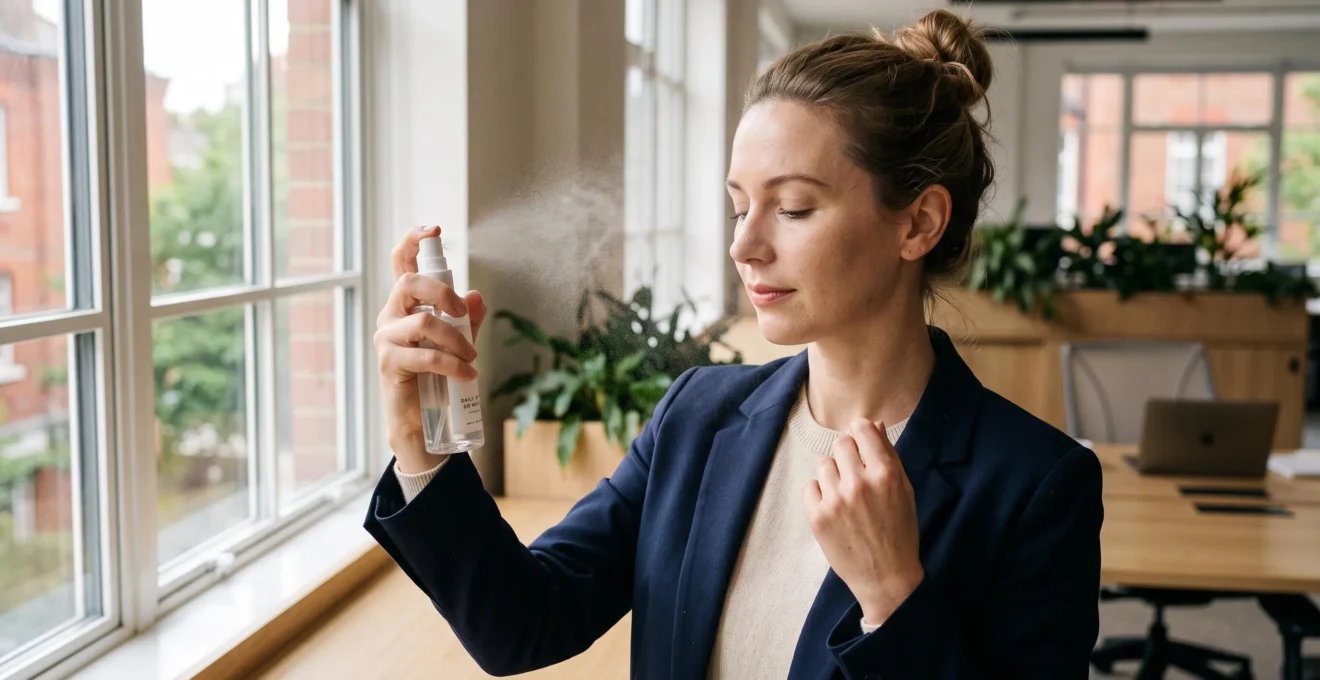
The lunchtime skincare dilemma is familiar to anyone who wears foundation: reapplying sunscreen as dermatologists recommend sounds sensible in theory, yet in practice often results in streaked makeup, greasy shine, and the professional appearance carefully constructed that morning sliding off by early afternoon. This frustration has led many to simply abandon midday sun protection altogether, despite investing in elaborate evening anti-ageing routines and understanding the importance of photoprotection.
The conflict between dermatological best practice and workplace reality is not a matter of vanity versus health. Modern galenic innovations have produced invisible sunscreen formulations specifically engineered to layer over makeup without disturbing foundation integrity, whilst maintaining the broad-spectrum UVA and UVB protection essential for preventing both photoageing and skin cancer risk. The challenge lies not in choosing between professional appearance and skin health, but in understanding which products and application techniques preserve both simultaneously.
This article examines the scientific gap between foundation SPF and dermatological protection standards, identifies the formulation characteristics that enable makeup-compatible reapplication, and provides precise protocols adapted to realistic UK exposure scenarios from office window desks to outdoor lunch breaks.
In this article
- Why foundation SPF fails as daily protection and the reapplication blind spot
- What makes invisible sunscreen formulas compatible with makeup: the science behind texture
- Three proven techniques to reapply sun protection without disturbing your foundation
- How often should you actually reapply based on your exposure level?
- Common reapplication mistakes that compromise both protection and makeup
- Building your reapplication kit for office, outdoor lunch and sport scenarios
- Protecting skin health without compromising professional appearance
Health information context
This article provides general guidance on sunscreen application practices for photoprotection. Individual skin conditions, photosensitivity, or specific medical circumstances may require personalised dermatological advice. For concerns about skin changes, unusual moles, or persistent sun damage, consult a qualified healthcare professional or dermatologist.
Why foundation SPF fails as daily protection and the reapplication blind spot
The SPF rating printed on foundation packaging creates a reassuring impression of built-in photoprotection, yet this number is based on laboratory testing conditions that may differ significantly from real-world makeup application. SPF values are calculated using a sunscreen application rate of 2 mg per square centimetre of skin, whereas people typically apply only a fraction of this amount when using cosmetic products.
SPF 5-7
Actual protection delivered by SPF 30 foundation when applied at typical cosmetic quantities (approximately 0.5mg/cm²), compared to the rated SPF 30 which requires 2mg/cm² application
This quantitative gap explains why foundation alone, regardless of its stated SPF rating, cannot serve as adequate photoprotection. Applying foundation at the dermatologically recommended 2mg/cm² would require a visibly thick layer incompatible with natural makeup appearance, transforming the face into what would resemble a mask rather than professional cosmetic enhancement. The product is formulated for coverage and complexion evening, not sun protection as its primary function.
Beyond the application quantity issue lies a second fundamental problem: photochemical filter degradation. The British Association of Dermatologists states that sunscreen should be reapplied at least every two hours, as protective filters break down over time when exposed to UV radiation. Even if sufficient foundation were applied at 7:30am before work, those UV filters would lose effectiveness by mid-morning through continuous exposure, whether from direct sunlight or the significant UVA radiation that penetrates office windows.
This UVA exposure through glass represents a commonly underestimated risk in UK office environments. Research published in the British Journal of Dermatology found that whilst window glass blocks all UVB radiation, it does not block all UVA, with transmission levels varying by glass type from 0.9% to 62.8%. Standard office windows allow substantial UVA penetration, the wavelength primarily responsible for photoageing including fine lines, pigmentation changes, and collagen degradation. The temperate British climate offers no protection against this process, as UVA penetrates cloud cover and remains present year-round.
Office window UVA exposure: Desk positions beside bay windows or floor-to-ceiling glass, common in modern British office design, create continuous UVA exposure throughout the working day. This cumulative exposure contributes significantly to photoageing and requires dedicated broad-spectrum protection beyond cosmetic products.
The frustration many experience when attempting traditional sunscreen reapplication over makeup stems from using formulations designed for beach or outdoor sports application rather than office cosmetic compatibility. Heavy cream textures, visible white casts from older mineral filter technology, and greasy residues that cause foundation to separate all reinforce the mistaken belief that photoprotection and professional makeup appearance constitute an impossible choice. Modern invisible fluid formulations, such as those incorporating photostable filter technologies like LA ROCHE POSAY Anthelios UVMune in water-light textures, demonstrate how galenic innovation resolves both requirements simultaneously rather than forcing compromise between them.
What makes invisible sunscreen formulas compatible with makeup: the science behind texture
The transformation from the thick white sunscreen creams that dominated the market a decade ago to today’s transparent fluids reflects significant advances in UV filter particle engineering and formulation dispersion technology. Understanding these galenic characteristics enables autonomous product identification rather than relying solely on trial-and-error purchasing.
Mineral UV filters—titanium dioxide and zinc oxide—historically created the notorious white cast problem because their particle size rendered them visible on skin. Modern formulations employ nanoparticle technology, reducing mineral filter particles to sizes below the visible light wavelength threshold, typically under 100 nanometres. These nano-sized particles maintain their UV-blocking photostability whilst becoming optically invisible upon application. Regulatory frameworks in the UK and EU require nanoparticle ingredients to be clearly labelled, allowing informed selection.
Chemical UV filters such as avobenzone, Mexoryl (ecamsule), and Tinosorb compounds achieve invisibility through complete dissolution in the formulation base rather than particle suspension. These organic filters absorb UV radiation through molecular structure rather than physical reflection, creating no visible residue regardless of application quantity. Modern photostable chemical filters like Mexoryl 400 resist the degradation that affected earlier-generation chemical sunscreens, maintaining UVA protection throughout the reapplication interval rather than breaking down within hours of exposure.
Texture engineering determines whether an invisible filter formula will layer successfully over makeup or create the greasy shine that ruins professional appearance. Water-weight gel and dry-touch fluid formulations incorporate silica microspheres or mattifying polymers that absorb excess sebum and create a powdery finish rather than the emollient slip characteristic of traditional cream sunscreens. These formulations dry down within seconds of application, forming a breathable protective layer that does not disturb underlying foundation or create additional shine on combination or oily skin types common in temperate climates.
Key formulation characteristics for makeup compatibility: Seek water-light or gel textures labelled as dry-touch or mattifying; chemical filters (avobenzone, Mexoryl, Tinosorb) or nano-mineral filters for invisible finish; broad-spectrum UVA/UVB protection with photostable filter technology; and fragrance-free formulations to minimise irritation when layering multiple skincare and cosmetic products.
The evolution from older zinc oxide formulations that sat visibly white on skin to contemporary invisible fluids addresses not only cosmetic elegance but also the adherence problem that determines real-world photoprotection outcomes. Products that feel heavy, look obvious, or interfere with makeup simply do not get reapplied, rendering their theoretical SPF rating irrelevant. Formulation science recognising this behavioural reality has produced solutions that serve both dermatological efficacy and practical daily compliance.
Three proven techniques to reapply sun protection without disturbing your foundation
The application method determines success as significantly as product selection. Rubbing or massaging motions—the instinctive approach when applying skincare—create friction that displaces foundation, whilst gentle pressing techniques allow protective layers to build without cosmetic disruption.
The pressing technique with invisible fluid sunscreen
This dermatologist-recommended method provides the most comprehensive reapplication coverage and works reliably across all makeup types from light tinted moisturiser to full foundation, powder, and blush combinations.
- Prepare with clean handsWash hands thoroughly or use hand sanitiser to prevent transferring desk dirt, phone bacteria, or environmental pollutants onto facial skin during application, which would both compromise skin health and affect makeup finish.
- Dispense appropriate quantityApply approximately 1/4 teaspoon of invisible fluid sunscreen onto fingertips—roughly the size of a large grape or two pumps from a standard dispenser bottle. This represents about half the initial morning application dose, providing meaningful protection renewal whilst acknowledging the practical constraints of over-makeup reapplication.
- Press onto forehead zoneUsing gentle downward pressing motions rather than rubbing, pat product onto the forehead in sections, working from the centre outward toward temples. The pressing action allows the fluid to settle between and over makeup layers without creating friction that would drag foundation.
- Continue across cheekbones and nosePress product onto cheekbones, nose bridge, and chin using the same gentle tapping technique. Pay particular attention to high points where sun exposure concentrates: the nose bridge, tops of cheekbones, and forehead, which are also the areas where photoageing signs appear earliest.
- Complete with peripheral zonesAddress frequently neglected areas including temples, hairline, jawline, and the delicate skin around eyes where separate eye cream SPF or careful gentle pressing is required. These zones often show premature ageing precisely because they receive inadequate daily protection.
The entire pressing technique requires approximately three minutes, a realistic addition to a lunch break or between-meeting interval. Allowing 30 to 60 seconds for the fluid to fully dry down before returning to work prevents any transfer to clothing or documents.
Mineral powder SPF for targeted touch-ups
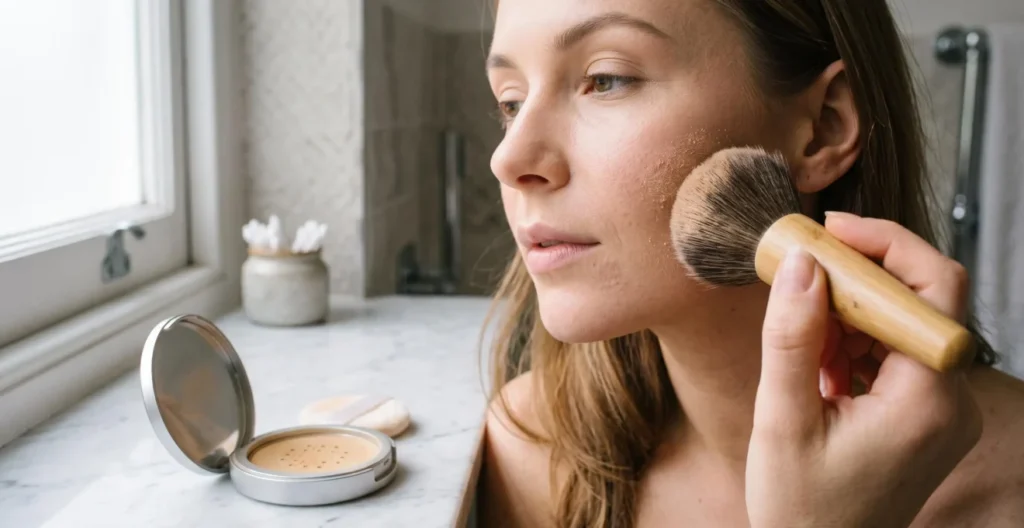
Translucent or tinted mineral powder SPF applied with a fluffy kabuki brush offers a faster alternative suitable for time-constrained scenarios or targeted reapplication on high-exposure zones. This method works particularly well for those wearing powder-based makeup or preferring a matte finish, as the powder simultaneously sets makeup whilst adding photoprotection.
Application focuses on forehead, cheekbones, nose bridge, and other prominent areas receiving direct exposure. Whilst powder SPF provides meaningful protection boost and certainly outperforms no reapplication at all, achieving the dermatologically recommended 2mg/cm² dose through powder application proves challenging. Consider this method complementary to fluid reapplication or as a pragmatic solution when full protocol is not feasible during a particularly busy workday.
SPF setting spray: supplementary rather than sole solution
SPF setting sprays appeal for their convenience and minimal makeup disturbance, yet their limitations must be understood to prevent over-reliance that compromises photoprotection. Misting delivers uneven product distribution, with some areas receiving adequate coverage whilst others remain inadequately protected. Achieving the quantity required for rated SPF protection through spray application would require extended misting that leaves skin visibly wet, defeating the quick-application advantage.
Setting sprays serve best as a supplementary step following pressing technique application to help set the reapplied layer, or as preparation before outdoor lunch segments when combined with powder touch-ups. They should not constitute the sole reapplication method for someone working beside windows throughout the day or spending extended periods outdoors.
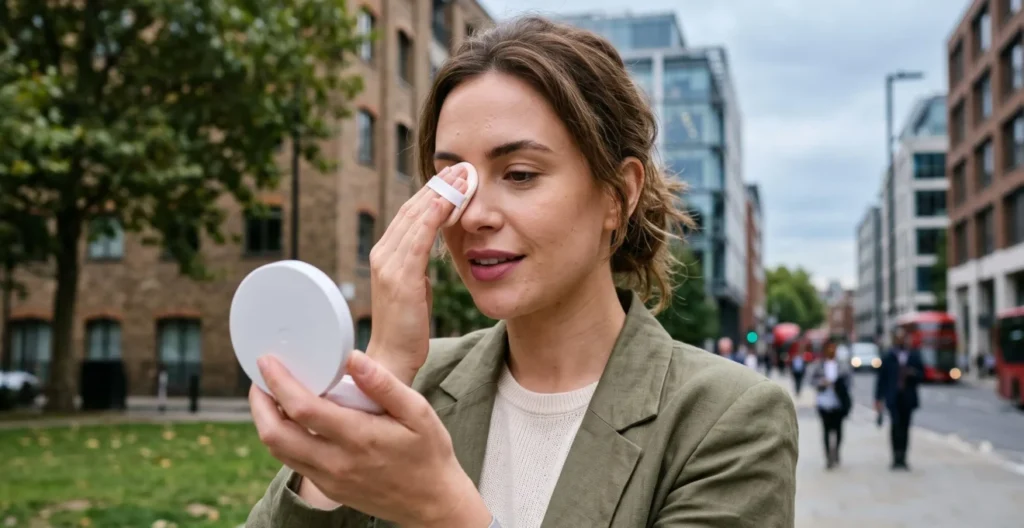
Comparing reapplication methods: Pressing technique with invisible fluid delivers comprehensive full-face coverage most comparable to initial morning application (3 minutes, optimal protection). Mineral powder brush application provides rapid targeted coverage for high-exposure zones (30 seconds, moderate protection). SPF setting spray offers convenient supplementary protection but insufficient as sole method (15 seconds, minimal protection as standalone approach).
How often should you actually reapply based on your exposure level?
The rigid two-hour reapplication rule frequently cited on social media reflects outdoor continuous sun exposure scenarios rather than the mixed indoor-outdoor reality of typical UK office work. Contextualising frequency recommendations to actual exposure patterns creates sustainable protocols rather than anxiety-inducing standards that prove impossible to maintain and therefore get abandoned entirely.
The British Association of Dermatologists advises reapplication at least every two hours during direct continuous sun exposure, acknowledging that protective UV filters break down over time when actively exposed to radiation. This timing applies to beach days, outdoor sports, gardening, or occupations involving extended outdoor work. For office-based professionals working primarily indoors with window exposure, a more realistic protocol involves a single strategic midday reapplication, typically between 12:00 and 13:00, providing renewed protection for the afternoon period.
Determining your reapplication frequency based on daily exposure scenario
- Full office day with windowed workspace:
Single midday reapplication around 12:30pm provides adequate protection renewal for indirect window exposure throughout the workday. Morning application at 7:30am plus midday reapplication covers the typical 9am-5pm office schedule. - Office day with outdoor lunch break or external meetings:
Reapply immediately before transitioning outdoors (typically 12:30-1pm before lunch, or before afternoon external appointment). The timing shift addresses elevated exposure during the outdoor segment rather than mechanical two-hour counting. - Continuous outdoor activity (weekend sports, outdoor work):
Strict two-hour reapplication protocol applies during prolonged direct sun exposure. For activities like park jogging, countryside walks, or outdoor events, set a two-hour timer from initial application and reapply consistently regardless of perceived sun intensity or cloud cover. - Predominantly indoor winter day with minimal outdoor exposure:
Realistic adjustment possible on low-UV winter days (December-February) spent almost entirely indoors away from windows. However, UVA penetrates clouds and remains present year-round, so maintain at least morning application even during darker months.
Factors intensifying reapplication urgency include desk position directly beside floor-to-ceiling windows rather than interior office locations, summer months when UV index reaches higher levels even in temperate UK climate, extended outdoor segments exceeding 30 minutes rather than brief 10-minute walks, and lighter skin phototypes with reduced natural melanin protection. Adjusting protocol based on these individual exposure variables creates intelligent personalised practice rather than rigid universal rule-following that ignores context.
The pragmatic principle bears emphasis: consistent midday reapplication on office workdays, even if not achieving perfect two-hour intervals, delivers vastly superior cumulative photoprotection compared to theoretical perfect protocols that prove unsustainable in practice and therefore get abandoned entirely. The photoprotection maintained across months and years of reliable single daily reapplication outweighs the marginal benefit of theoretically optimal timing that cannot be realistically maintained.
Common reapplication mistakes that compromise both protection and makeup
Certain frequent errors simultaneously reduce photoprotection efficacy and damage makeup appearance, creating the double failure that reinforces the mistaken belief that these objectives cannot coexist. Understanding these mistakes enables correction that serves both health and cosmetic goals.
Critical error: Insufficient quantity application: Applying only a symbolic trace amount creates false security of protection whilst providing negligible UV defence. Research demonstrates that using even 50% of the recommended sunscreen dose does not deliver 50% of the rated protection, but rather exponentially reduced efficacy. A token application for makeup preservation purposes fails at both objectives, as the inadequate uneven distribution often creates patchy appearance whilst leaving skin unprotected.
Rubbing or massaging product instead of pressing represents the single technical mistake most responsible for cosmetic catastrophe. The friction from rubbing motions drags foundation across the skin surface, creating streaks, removing coverage, and producing the exact outcome that discourages future reapplication attempts. This same friction creates uneven UV filter distribution with protection gaps across facial zones. Correcting this single technique element—pressing rather than rubbing—transforms outcomes dramatically, enabling both protection and makeup preservation.
Product formula mismatch occurs when heavy cream-textured SPF or traditional mineral sunscreen with visible white cast gets used over makeup, typically because the product is what happens to be available rather than intentionally selected for over-makeup compatibility. The resulting greasy residue, white streaks, or foundation sliding validates the frustration from past failed attempts whilst obscuring that the problem lies in formulation selection rather than fundamental incompatibility between photoprotection and makeup.
Neglecting critical high-exposure zones during reapplication creates protection gaps in the anatomical areas where photoageing signs appear earliest and skin cancer risk concentrates. Focusing only on the central face where makeup preservation concern is highest whilst missing forehead hairline, temples, tops of ears, nose bridge, and the delicate lower eyelid area leaves the highest-risk zones undertreated. These peripheral areas require conscious attention during reapplication to ensure comprehensive coverage.
Attempting reapplication over sebum-saturated or degraded makeup without any preparation compromises both SPF adhesion to skin and cosmetic result, as the product cannot properly layer over an oily unstable base. A 10-second preparation step using blotting papers to remove excess oil from the T-zone before reapplication dramatically improves both sunscreen layering effectiveness and makeup appearance, yet commonly gets skipped in rushed application scenarios.
Building your reapplication kit for office, outdoor lunch and sport scenarios
Transforming knowledge into sustained behaviour requires removing the practical barriers that prevent action even when intention exists. Assembling context-specific reapplication kits stationed in strategic locations eliminates the “I don’t have the product with me” obstacle that causes abandonment following a single forgotten instance.
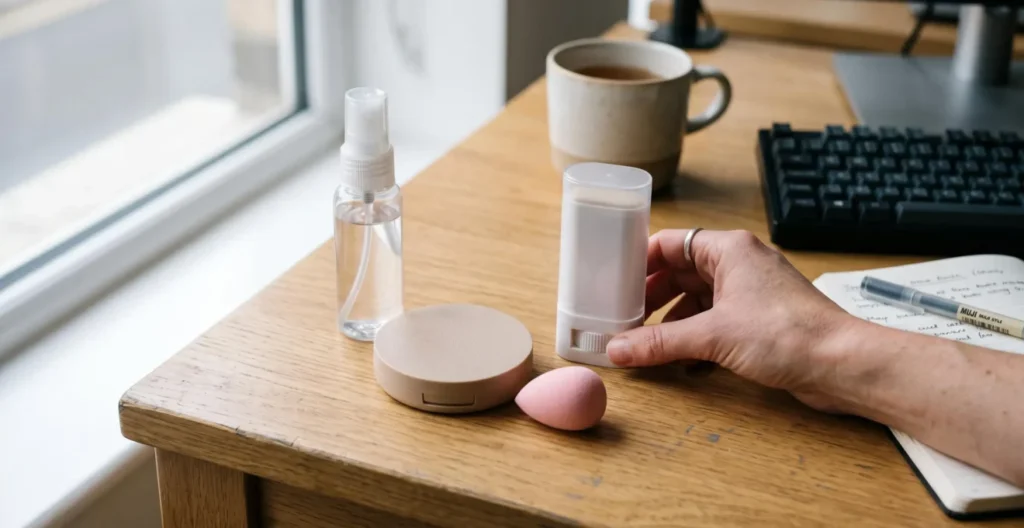
- Office desk kit for indoor workday protectionStation a 30-50ml travel-size invisible fluid sunscreen permanently in a desk drawer, eliminating the “forgot to bring it” barrier that disrupts nascent habits. Include a compact mirror for checking application completeness and optional blotting papers for sebum removal before midday reapplication. The permanent desk location creates a visual reminder whilst ensuring product availability regardless of what was remembered or forgotten when leaving home that morning. Travel-size invisible fluids such as formulations incorporating technologies like Mexoryl in 30ml formats demonstrate the desk-drawer-friendly sizing that facilitates daily kit preparation without occupying significant workspace.
- Handbag portable kit for elevated outdoor exposureAssemble a lightweight kit for the handbag or work bag carried daily, enabling strategic reapplication before transitioning outdoors for extended lunch, terrace meetings, or walking appointments. Include a 15-30ml portable invisible fluid or stick format for pressing technique application, plus a compact mineral powder SPF for rapid touch-ups when time is constrained. The handbag integration ensures daily carry compliance without requiring conscious decision-making each morning about whether to pack photoprotection. A stick format offers mirror-free application advantage, allowing discreet reapplication even without access to bathroom facilities.
- Sport and high-activity weekend kit for intensive outdoor exposurePrepare a dedicated kit for the gym bag or weekend activity bag containing water-resistant stick or gel formula suitable for high-sweat contexts like park jogging or outdoor exercise. Sweat-resistant formulations maintain protection effectiveness despite perspiration, whilst stick formats enable reapplication during activity without requiring mirror, clean hands, or stopping the workout entirely. Include larger 50ml quantity for both face and exposed body areas (neck, chest, backs of hands) receiving significant exposure during outdoor sport. The strict two-hour reapplication protocol applies during continuous outdoor exercise regardless of perceived sun intensity or cloud cover.
Strategic stationing creates behavioural redundancy: desk kit for typical workdays, handbag kit for outdoor lunch scenarios, car glovebox backup for unexpected outdoor segments. This multiple-location approach prevents the complete abandonment that often follows a single instance of forgotten product, maintaining the consistent practice that delivers meaningful photoprotection outcomes across months and years.
Product selection for each kit should prioritise invisible finish, broad-spectrum UVA and UVB protection, photostable filter technology, and appropriate format for the usage scenario. Purchasing travel sizes or decanting from larger bottles into portable containers keeps each kit appropriately sized whilst managing cost. Sunscreen products typically have a period-after-opening of 12 months when stored at room temperature, making desk drawer or car glovebox stationing acceptable provided products are replaced annually.
Protecting skin health without compromising professional appearance
The perceived incompatibility between dermatological sun protection recommendations and maintaining professional makeup throughout the workday reflects outdated product formulations and application techniques rather than fundamental conflict between these objectives. Modern invisible sunscreen formulations engineered with nano-particle mineral filters or photostable chemical filters, combined with pressing application techniques that build protective layers without creating friction, enable effective photoprotection renewal without the greasy residue, white streaks, or foundation displacement that characterised earlier attempts.
The quantitative gap between typical foundation application and dermatological protection standards, combined with photochemical filter degradation throughout the day, establishes that relying solely on makeup SPF—regardless of its rating—cannot deliver adequate continuous photoprotection. Yet this scientific reality need not translate into choosing between skin health and professional cosmetic appearance. Strategic midday reapplication adapted to realistic UK office exposure patterns, using makeup-compatible invisible fluid formulations and gentle pressing techniques, preserves both objectives simultaneously.
Assembling context-specific reapplication kits stationed in desk drawers, handbags, and gym bags transforms intention into sustainable behaviour by removing the practical barriers that cause abandonment even when knowledge and motivation exist. The photoprotection maintained through consistent imperfect practice outweighs theoretically optimal protocols that prove impossible to maintain within the constraints of professional work schedules, social commitments, and daily life complexity.
For those observing early photoageing signs in colleagues working beside windows, or recognising the disconnect between investing in evening anti-ageing serums whilst neglecting daytime UV defence, the pathway forward requires neither additional skincare complexity nor sacrifice of carefully constructed professional appearance. The solution lies in selecting formulations designed for over-makeup compatibility and adopting application techniques that respect rather than disturb existing cosmetic layers, creating a midday photoprotection routine as maintainable as the morning skincare protocol already established.